UK Protein and Fibre Food Market 2026: How GLP-1 Drugs, Fibremaxxing and the Own-Label Arms Race Are Rebuilding British Grocery
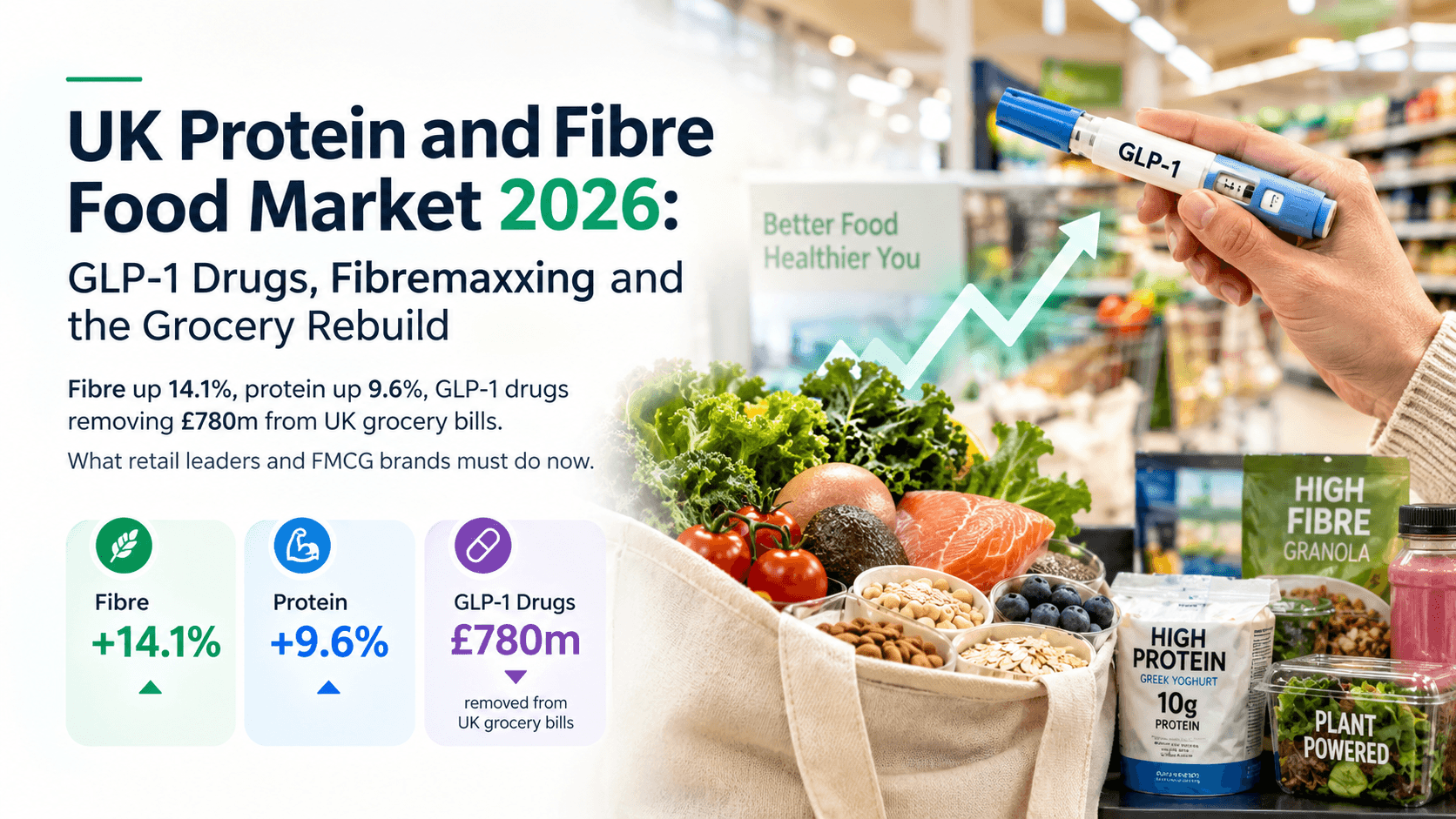
Fibre is up 14.1%. Protein is up 9.6%. GLP-1 drugs have removed £780 million from UK grocery bills. Here's what retail leaders and FMCG brands need to do before the window closes.
Protein-heavy yoghurts and fibre-packed snack bars used to live in a specialist section, often labelled something like "health and wellness" and largely ignored by the average midweek shopper. Not anymore.
Today, high-protein ready meals are launch priorities for Sainsbury's, M&S and Waitrose. Fibre snack searches on Ocado are up 2,578% versus prior periods. Greek yoghurt is having its biggest volume boom in years. And behind all of this, a new force is reshaping grocery more fundamentally than anything in recent memory: the rapid rise of GLP-1 weight loss drugs -- Ozempic, Wegovy, Mounjaro -- whose 1.9 million UK users are eating less, but demanding far more from every bite.
This article is for retail leaders, category managers and FMCG brand owners who need to understand what's actually happening, what the data says, and where the commercial opportunity sits. Here's the sharpest fact to hold in your head: protein and fibre are growing at more than double the rate of the overall FMCG market. That's not a trend. It's a structural reset -- and the window to act before the category is fully priced in is narrowing fast.
1. The Numbers That Matter Right Now
Before getting into why, here's what the data is showing.
NielsenIQ (NIQ) recorded protein food sales growing at +9.6% and fibre food sales at +14.1% in the last 26 weeks -- against an overall FMCG market growing at +4.1% in the same period. Protein and fibre aren't just outperforming. They're running at more than double the rate of the overall market.
| Metric | Figure | Source |
|---|---|---|
| Protein food sales growth (last 26 weeks) | +9.6% | NIQ, Feb 2026 |
| Fibre food sales growth (last 26 weeks) | +14.1% | NIQ, Feb 2026 |
| FMCG market average growth | +4.1% | NIQ, Feb 2026 |
| Products labelled "high source of protein" growth | +4.4% in four weeks to Aug 2026 | NIQ, Aug 2026 |
| High-protein ready meal searches, Sainsbury's | +300% YoY | Sainsbury's, Jan 2026 |
| High-protein searches, Sainsbury's | +57% YoY | Sainsbury's, Jan 2026 |
| Fibre-rich meal sales growth, Ocado | +187% YoY | Ocado, Apr 2026 |
| High-protein ready meal sales, Ocado | +91% YoY | Ocado, Apr 2026 |
| Kefir sales growth, Ocado | +42% YoY | Ocado, Apr 2026 |
| Fibre snack searches, Ocado | +2,578% | Woodford Food, 2026 / The Grocer 2026 |
| Fibre searches on Ocado (YoY 2025) | +57% | The Grocer, Jun 2026 |
| UK protein snacks market (2026) | £431m (USD 551.6m) | Future Market Insights |
| GLP-1 users spending less on groceries | £780m removed from UK grocery bills | Worldpanel by Numerator, Jun 2026 |
These are not quarterly blips. This is a category in structural growth, driven by overlapping and reinforcing forces.
Growth direction: Protein and Fibre vs. FMCG average (indexed, last 26 weeks):
FMCG market avg  ████░░░░░░░░░░░░░░░░░░░░░░░░░░  +4.1%
Protein foods    ████████████████████░░░░░░░░░░  +9.6%
Fibre foods      █████████████████████████████░  +14.1%
One in four UK households now say health is their number one priority for the year ahead, according to NIQ's panel of 30,000 GB households. That's the demand base. The rest of this article is about where the money is actually flowing.
2. Three Engines Driving the Shift
Unlike most trends, the protein and fibre surge isn't being driven by one thing. There are three distinct forces pushing in the same direction at once -- which is precisely why the momentum feels different this time.
Engine 1: GLP-1 Weight Loss Drugs
The most significant commercial force reshaping UK grocery in 2026 isn't a new product or a marketing campaign. It's a prescription drug.
According to Worldpanel by Numerator, the number of British households with a GLP-1 user has nearly tripled in two years, with 6.3% of households now including at least one user in 2026 -- up from 4.1% in 2025 and just 2.3% in 2024. That equates to 1.9 million adults currently taking weight-loss medication.
Grocery spend by GLP-1 user households has fallen by £780m, with 299 million fewer packs purchased across the analysis period. This equates to a £418 decline in spend per household compared with non-user households.
The drugs suppress appetite -- people simply want less food. But what they do eat, they want to work harder. At the same time, demand is shifting towards fresh food, protein-rich products and meals perceived as offering greater nutritional value.
PwC estimates that the introduction of pill-form treatments could more than double current UK uptake, increasing the number of users from around 3 million to 7 million -- roughly 13% of UK adults. And critically: more than 80% of former users said they had maintained at least some of the dietary and grocery changes adopted while taking GLP-1s. These habits are sticky, even after people stop taking the medication.
Women remain significantly more likely to use GLP-1s, accounting for 77% of current users. More than half of users (52%) now describe their eating style as mindful, guided by hunger cues rather than habit.
Engine 2: Social Media and the Fibremaxxing Movement
The second driver is happening on TikTok and Instagram, and it's moving shelf sales faster than most TV campaigns ever did.
Social media has helped accelerate the fibre trend, particularly through the rise of "fibremaxxing" content on TikTok and Instagram. "We're seeing a real shift in consumer understanding of fibre," says Jon Walsh, co-founder and CEO of Bio&Me. "Consumers are now increasingly 'fibre aware', asking broader questions around fibre content, as well as ingredient quality."
The "30 plants" movement -- where people aim to eat 30 different types of plants each week to support gut diversity -- has moved from wellness niche to mainstream conversation. Two in five (40%) of the general population now buy functional drinks several times a month, rising to nearly two thirds (61%) of Gen Z.
60% of Gen Z and younger Millennials now follow a specific diet, and they show a strong preference for single-serve products that prominently display protein content and feature clean-label ingredients.
Engine 3: NHS Nutrition Awareness and Long-Term Health Thinking
The third engine is quieter but durable. Ocado's senior nutritionist Charlie Parker noted: "We are seeing that our customers -- particularly younger consumers -- are thinking about health in a long-term way. It's less about chasing short-term diet trends -- and more about investing in wellbeing through everyday choices."
People aren't just reacting to a trend. They're building habits around gut health, muscle maintenance, and long-term energy management. That's a different kind of shopper, and they require a different kind of range.
Key insight: When TikTok, GLP-1 medication and NHS health messaging are all pointing at the same category at the same time, that's not a trend cycle -- that's a platform shift.
3. The GLP-1 Grocery Effect in Detail: Winners and Losers
It's worth spending more time on the GLP-1 story, because it has specific category-level implications that most UK retailers haven't fully processed yet.
The drugs work by mimicking hormones that regulate appetite, making users feel full faster and stay full longer. The result: people eat less overall, but they become much more intentional about the nutritional value of what they do eat.
68% of users are taking GLP-1s specifically to lose weight. Crucially, this is no longer purely a medical phenomenon. Over a quarter of respondents said they would use a GLP-1 medication to lose weight even without a major health condition.
This is a population of shoppers who are spending less in total but prioritising quality and nutrition over everything else. For the right FMCG brands and categories, that's an upgrade opportunity. For the wrong ones, it's volume pressure.
Categories under pressure from GLP-1 users:
- Crisps and savoury snacks
- Confectionery and sweet bakery
- Processed ready meals (standard)
- Alcohol
- Large portion formats
Categories benefiting:
- High-protein ready meals
- Fibre-rich snacks and cereals
- Greek yoghurt and protein dairy
- Fresh produce
- Kefir, kombucha and gut-health drinks
- Nutrition bars (high protein, lower sugar)
- Smaller, nutrient-dense meal formats
Consumers taking GLP-1 drugs have reported cutting back on products including crisps, confectionery, processed food and alcohol as reduced appetites and fewer cravings change established eating habits.
The GLP-1 shopper is demanding quality density -- not fewer calories in an otherwise unchanged product. A 350-calorie meal that delivers 30g of protein, meaningful fibre and counts as one of your five-a-day is far more attractive to this shopper than a 250-calorie meal with limited nutritional value. That's a fundamental reframing of what "healthy ready meals" needs to mean.
What a GLP-1-Friendly Product Actually Looks Like
Based on the ranges launched by Sainsbury's, M&S, Waitrose and Morrisons, the brief is consistent across the market:
| Attribute | GLP-1-Friendly Target | Standard Ready Meal Average |
|---|---|---|
| Portion size | 250--350g | 400--550g |
| Protein content | 20g+ per portion | 15--18g per portion |
| Fibre content | 3g+ per portion (good source) | 1--2g per portion |
| Calorie range | Under 400 kcal | 400--600 kcal |
| Five-a-day contribution | At least 1 count | Often 0 |
| Labelling | Explicit protein/fibre callout | Calorie-focused only |
For retail leaders: The question to ask your category team is: if 13% of UK adults are eventually on GLP-1 medication, and they're all spending £418 less per year on groceries but concentrating that spend on nutrient-dense products -- where is your range positioned to win that spend?
4. Protein: From Gym Bag to Grocery Gondola
Protein used to belong to two tribes: serious gym-goers and elite athletes. That's no longer true. Protein has gone mainstream, and the data proves it at scale.
Sainsbury's online searches for "high protein" are up +57% year on year, and searches for "high protein ready meals" have increased by 300% year on year. In response, Sainsbury's launched 19 new high-protein own-label products in January 2026, spanning ready meals, breakfast products, bakery items and yoghurts -- all under a dedicated High Protein range.
Alongside the high protein launches, Sainsbury's introduced its new "Small but Mighty" meals -- under 350 calories, each meal is high in protein and fibre to help support nutritional needs of customers with reduced appetites. These were explicitly developed with a registered dietitian and designed with GLP-1 users in mind.
Sainsbury's wasn't alone. Sainsbury's follows retailers including Ocado, Marks & Spencer, Waitrose and Greggs in advertising new ranges catering for those taking GLP-1 drugs. Morrisons launched GLP-1-friendly own-label ready meals in partnership with Applied Nutrition in January 2026. The Co-op rolled out "mini meals" -- 250g-280g nutrient-dense pots. The supermarket arms race on functional protein is well and truly underway.
Brand-level, the market is maturing fast. Grenade -- the UK's best-selling protein bar since 2016, founded in Birmingham -- was acquired by Mondelēz International (owner of Cadbury and Oreo) in a deal valued at approximately £200 million. Grenade's Carb Killa protein bars had grown to the point where they outsell single Mars bars in UK supermarkets. A confectionery giant buying a protein bar brand is perhaps the clearest signal of where the category is heading -- towards the mainstream, not away from it.
The food and beverage sub-segment held 42.34% of the UK protein market in 2025, with supplements projected to grow at a 6.47% CAGR to 2031. Within that, functional convenience -- chilled ready meals, snacks, food-to-go -- is the highest-growth format.
Our own deep-dive into The Gym Kitchen's UK retail strategy showed exactly how a challenger protein brand is navigating this moment -- building listings across Tesco, Asda, Sainsbury's and Morrisons simultaneously while leaning hard into the GLP-1 shopper opportunity. The playbook is increasingly clear for brands that commit.
Greek yoghurt is one of the best illustrations of protein going mainstream. Kantar data shows Greek yoghurt volumes up 39% year on year in 2024 -- driven entirely by everyday shoppers, not fitness enthusiasts. The M&S high protein bang bang chicken was up 45% year on year on Ocado. The M&S high protein cod, scallop and prawn linguine was up 389%.
High-Protein Product: Nutrition Benchmark Comparison
| Product Format | Protein (per 100g) | Fibre (per 100g) | Avg. Price (UK, 2026) | Primary Retailer |
|---|---|---|---|---|
| High-protein Greek yoghurt (branded) | 8--10g | 0g | £1.80--£2.20 / 150g | All major multiples |
| Sainsbury's High Protein ready meal | 15--20g | 3--5g | £3.50--£4.50 | Sainsbury's own-label |
| Morrisons GLP-1 ready meal (Applied Nutrition) | 20--25g | 4--6g | £3.00--£4.00 | Morrisons own-label |
| M&S high protein ready meal (premium) | 20--30g | 3--5g | £5.00--£7.00 | M&S Food |
| Grenade Carb Killa bar | 20g / bar | 1--2g | £1.80--£2.20 | All major multiples |
| Standard supermarket ready meal (non-functional) | 8--12g | 1--2g | £2.50--£4.00 | Generic own-label |
The commercial reality: Protein is no longer a health claim -- it's a baseline expectation. Shoppers are reading labels for protein content the way they used to read them for calories. If your product doesn't show the number prominently, it's losing at the shelf.
5. Fibre: The Sleeper Category That Just Woke Up
If protein has been the headline act, fibre is the support act that's about to steal the show.
From cereals and snack bars to yoghurts and functional drinks, high-fibre claims are appearing on packs at an unprecedented rate as brands rush to capitalise on growing consumer interest in gut health. While probiotics, kefir and fermented foods dominated the first wave of the gut health boom, fibre is increasingly emerging as the nutrient consumers are actively seeking out.
The search data tells the story more dramatically than almost any other metric: fibre snack searches on Ocado rose by 2,578%, pointing to a sustained, genuine consumer shift rather than a short-lived interest spike. Separately, searches on Ocado for fibre rocketed 57% year on year in 2025 as proof that consumers are on the lookout for new products to boost their fibre intake.
The "30 plants" movement -- eat 30 different types of plants in a week -- has been one of the most commercially effective health frameworks to emerge from social media. It's clear, it's achievable, and it's directly tied to product choice. A consumer aiming for 30 plants is actively scanning labels for fibre content, actively reaching for diverse grains, seeds and legumes, and actively building variety into their weekly shop.
The gut health connection is key. Fibre feeds the gut microbiome -- the colony of bacteria in the digestive system that affects everything from immunity to mood to energy levels. The so-called "four Ks" of gut health -- kimchi, kefir, kombucha and kraut -- have graduated to supermarket staples. Sales of kombucha are climbing fast, and fizzy "probiotic sodas" are bubbling up in trendy bars as alternatives to beer.
Consumers are actively seeking out ingredients proven to help stimulate GLP-1 production in the body: high-fibre foods like oats and legumes, fermented products such as kefir and kimchi, healthy fats like avocados, and bitter foods including cavolo nero and grapefruit.
This is where the fibre and GLP-1 trends intersect in a particularly interesting way. High-fibre foods slow digestion and improve feelings of fullness -- which is precisely what GLP-1 users, and shoppers generally trying to manage their appetite and energy, are looking for. The category alignment is almost perfect.
Fibre Content Comparison: UK Supermarket Products vs. NHS Daily Target
The average UK adult eats around 18g of fibre per day against an NHS recommendation of 30g. That 12g daily deficit is both a public health problem and a commercial opportunity:
| Product | Fibre per Serving | % of Daily Target (30g) | Retailer / Brand |
|---|---|---|---|
| Bio&Me Super Gut Granola (45g) | 7.5g | 25% | Major multiples |
| High-fibre All-Bran (40g) | 10g | 33% | Kellogg's / all multiples |
| Standard white bread (2 slices) | 1.3g | 4% | Own-label |
| Ocado fibre-rich ready meal (avg.) | 5--7g | 17--23% | Ocado / M&S |
| Typical crisps snack pack (30g) | 0.7g | 2% | Various |
| High-fibre snack bar (new launches) | 4--6g | 13--20% | Indie brands |
| Average UK adult daily intake | 18g | 60% | NHS / BNF data |
| NHS recommended daily target | 30g | 100% | NHS |
The gap: Most UK adults eat around 18g of fibre per day against an NHS recommendation of 30g. That gap is both a public health problem and a commercial opportunity of significant size. Brands and retailers that make fibre easy, delicious and clearly signposted are sitting on an underserved market.
Bio&Me -- which GrowSights profiled when it won SME Brand of the Year 2026 -- is perhaps the clearest example of a brand built for this exact intersection. Its granolas, porridges and gut-health products are built around the 30-plants framework and have grown into major UK retailers precisely because the category demand arrived to meet them.
6. The Supermarket Own-Label Arms Race
One of the most telling signals of how seriously UK grocery is taking the protein and fibre shift is the pace of own-label development. When supermarkets invest their own brand equity in a category, they're not following a trend -- they're confirming it.
Sainsbury's has moved most aggressively. With online searches for "high protein" up 57% year on year, the retailer has answered the call for functional nutrition with 19 high-protein own-label products -- from ready meals to breakfast essentials -- designed to help customers eat well without compromising on flavour or convenience. The "Small but Mighty" range is explicitly positioned for GLP-1 users and those with reduced appetites.
Marks & Spencer has built a premium health halo across its range that commands genuine price premium. The success of its high-protein ready meals on Ocado -- particularly the +389% YoY growth of the high protein cod, scallop and prawn linguine -- shows that premium functional food at M&S price points has a real and growing market.
Waitrose has been investing in functional food NPD, including collaborations with specialist health brands that bring credibility the own-label alone couldn't generate. Its shoppers index highly for health-consciousness and willingness to spend on quality nutrition.
Morrisons was first to explicitly launch GLP-1-friendly own-label ready meals, partnering with Applied Nutrition in January 2026 -- showing that even a value-leaning grocer sees the functional food opportunity as commercially viable.
Ocado has become the most important data-revealing platform in UK functional food. Because its customers tend to be health-conscious and early-adopting, Ocado search and sales trends consistently predict what will hit mainstream grocery 6-12 months later. When Ocado shows fibre-rich meal sales up 187% and high-protein ready meals up 91%, that's a leading indicator, not a lagging one.
Private-Label Penetration Gap: Functional vs. Conventional Protein
The private label opportunity in functional food is significant and underexploited at the mid-market level. A 70% gap in private label penetration exists between processed meat (82%) and alternative proteins (15%) -- one of the most immediate commercial levers available to retailers.
| Category | Branded Market Share | Own-Label Share | Own-Label Gap vs. Processed Meat |
|---|---|---|---|
| Processed meat | 18% | 82% | Baseline |
| Standard ready meals | 35% | 65% | -17 pts |
| High-protein ready meals | 60% | 40% | -42 pts |
| Protein bars and snacks | 85% | 15% | -67 pts |
| High-fibre snacks (new) | 78% | 22% | -60 pts |
| Gut-health drinks (kefir/kombucha) | 72% | 28% | -54 pts |
The own-label gap across functional protein and fibre formats is enormous. Retailers that move to close it -- at accessible price points -- build loyalty, margin and category authority simultaneously. The premium end has branded players. Own-label at accessible price points is still wide open.
For a view on how to build the commercial case for functional health ranging into a retailer category review, our range review data pack guide covers exactly the kind of evidence stack that moves buyer conversations in this space.
7. The Social Media Effect: How Trends Become Categories
It would be a mistake to dismiss the role of social media in what's happening here. This isn't just influencer marketing -- it's category creation in real time.
One standout example is mushroom coffee -- a blend of coffee and adaptogenic fungi such as lion's mane and chaga -- which has seen year-on-year searches on Ocado skyrocket by 1,552%. Matcha sales are up 67% since the previous year, with Dirtea Matcha surging 6,000%.
These numbers would be extraordinary for any product at any point in grocery history. What they represent is TikTok-driven discovery converting into real shelf sales at scale -- and doing so faster than any traditional media buy could manage.
"Fibremaxxing" -- the trend of maximising your daily fibre intake -- has become one of the most searched health topics on social platforms. Content showing people adding chia seeds, flaxseeds, psyllium husk and high-fibre vegetables to everyday meals has accumulated hundreds of millions of views. The commercial effect is visible in the data: products that carry high-fibre claims, that feature prominently in "what I eat" content, or that have been endorsed by credible nutritionist creators are seeing volume uplift that bears no relationship to their traditional marketing spend.
For FMCG brands, this creates both opportunity and urgency. A product that captures TikTok's attention in this category can go from niche to mainstream very quickly -- but without supply chain readiness, distribution agreements and on-shelf availability, that moment evaporates. The lessons from fast-moving drinks brands in this space are directly applicable. See our analysis of UK consumer spending and how fast behavioural shifts ripple through grocery for context on how quickly category dynamics can turn.
For brands: Social media is now a category intelligence tool as much as a marketing channel. If a nutritional claim is generating organic content on TikTok, it will show up in Ocado search data within weeks. Build the product pipeline accordingly.
8. Category Winners and Losers: The Commercial Picture
With three simultaneous growth drivers in play, some categories are winning clearly. Others are under genuine structural pressure. Here's the honest picture.
| Category | Trajectory | Key Driver | Retail Signal |
|---|---|---|---|
| High-protein ready meals | Strong growth | GLP-1 + consumer demand | All major supermarkets launching own-label |
| Greek yoghurt and protein dairy | Very strong (+39% volume, Kantar 2024) | Protein mainstream adoption | Expanding fixture space in chilled |
| Fibre-rich snacks and cereals | Fast emerging (+2,578% search, Ocado) | Fibremaxxing + gut health | NPD pipeline accelerating, The Grocer Jun 2026 |
| Kefir and fermented dairy | Strong (+42% YoY, Ocado) | Gut health trend | Moving from niche to mainstream section |
| Kombucha and probiotic drinks | Growing (+22% YoY, Ocado) | Gut health + no-alc crossover | Independent brands + supermarket own-label |
| Protein bars and nutrition snacks | Mainstream (£1.2bn market) | Gym culture gone mainstream | Strong branded + emerging own-label |
| Functional drinks (protein/fibre/gut) | +54% YoY (Ocado health drinks) | Gen Z + GLP-1 | Fastest emerging format |
| Standard confectionery | Under pressure | GLP-1 reduced cravings + HFSS rules | Declining share in baskets of key segments |
| Standard crisps and savoury snacks | Under pressure | GLP-1 + health awareness | GLP-1 users down -11.5% on crisps (McKinsey) |
| Ultra-processed ready meals (no functional claim) | Declining | GLP-1 + UPF awareness | Own-label repositioning required |
| Sugary cereals | Declining | Fibre and protein awareness | Losing to high-protein alternatives |
The overall picture: anything that combines protein, fibre or gut-health credentials with convenience, accessibility and good taste is winning. Anything that relies purely on indulgence, impulse or portion size is facing volume headwinds it hasn't seen before.
9. Risks and What Could Slow This Down
It would be wrong to present this as frictionless momentum. There are genuine risks that could slow or complicate the protein and fibre boom -- and category managers should model for them.
Risk 1: Regulatory reclassification of health claims The UK's post-Brexit regulatory landscape for food health claims is still evolving. Any tightening of what qualifies as "high protein" or "source of fibre" under retained EU regulation could force reformulations and relabelling across the category. Several brands are already operating close to the claim thresholds.
Risk 2: GLP-1 availability and NHS prescribing constraints GLP-1 adoption projections assume continued supply and NHS support. Supply shortages, prescribing restrictions or price changes could slow uptake -- and with it, the structural shift in shopper behaviour that is underpinning much of the premium functional food growth.
Risk 3: Consumer fatigue with health claims "Protein" has been on-pack long enough that some consumers are becoming sceptical of unsubstantiated claims. Brands that have added protein callouts without meaningful reformulation are already seeing lower conversion than genuine high-protein products. Greenwashing-equivalent scepticism around health claims is a real and growing risk.
Risk 4: Own-label commoditisation squeezing branded margins As all the major supermarkets develop their own high-protein and high-fibre ranges, the price gap between branded and own-label products in this category will tighten. Branded players that have grown on novelty and early mover advantage will face real margin pressure within 18-24 months.
Risk 5: Supply chain volatility for specialist ingredients High-fibre and functional ingredients -- psyllium husk, diverse grain mixes, live cultures for fermented products -- have longer and more complex supply chains than conventional food inputs. The brands most exposed are those that have driven fast growth without locking in ingredient supply.
10. What Mid-Market Retailers Are Getting Wrong
The major grocers are responding. The mistake made by many mid-market operators is waiting to see what Tesco and Sainsbury's do before moving -- by which point, the commercial opportunity has already been captured.
Mistake 1: Treating "health food" as a section, not a strategic lens
The shoppers driving the protein and fibre surge don't go to the health food aisle. They want high-protein products in the ready meals section, fibre claims in the breakfast aisle, and gut-health positioning on the yoghurt fixture. Health is a lens across the whole store, not a ghetto in aisle 14.
Mistake 2: Over-indexing on "free-from" labels, under-investing in "good-for" claims
"Free from gluten" or "free from sugar" still has a place. But the growth is in positive functional claims: high in protein, source of fibre, contains live cultures, 5 of your 30 plants. Shoppers in 2026 are looking for what a product gives them, not just what it removes.
Mistake 3: Ignoring the dual-claim opportunity
The most commercially powerful positioning in this category is the product that is both high in protein AND high in fibre -- because it satisfies two shoppers at once and aligns with GLP-1 users' specific needs (protein for satiety and muscle maintenance, fibre for digestion and gut health). Relatively few products have made this dual claim their primary message. That's a gap.
Mistake 4: Not signposting GLP-1-friendly options
Sainsbury's, M&S, Waitrose, Morrisons, Greggs and Ocado have all explicitly positioned ranges for consumers with reduced appetites or GLP-1 users. 40% of GLP-1 users want smaller portion sizes on menus, and 26% want GLP-1-friendly menu sections. Mid-market retailers who don't acknowledge this shopper are already invisible to a fast-growing part of their customer base.
Mistake 5: Missing the on-shelf execution
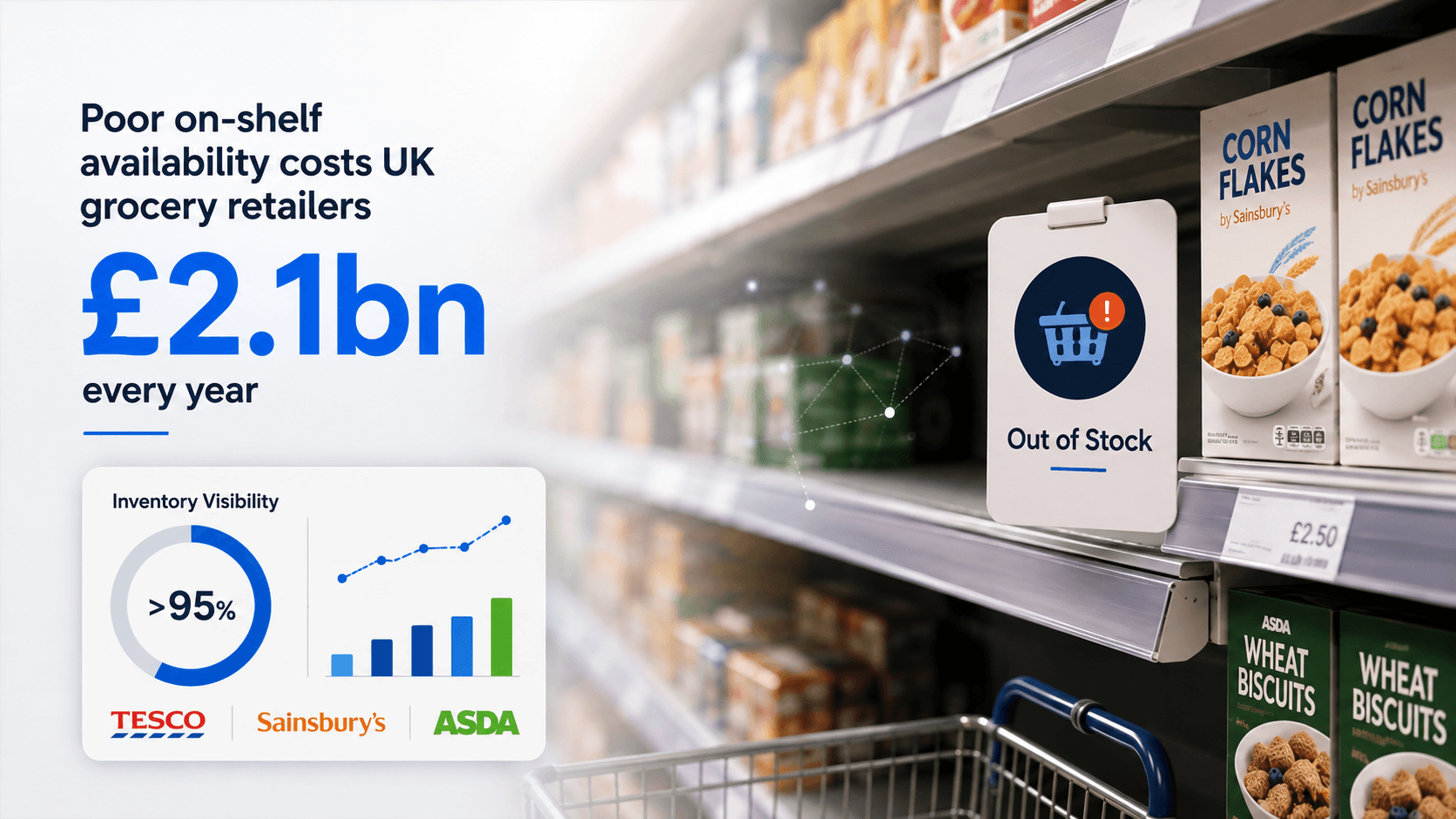
Winning a listing for a high-protein or high-fibre product means nothing if the shelf is empty when the customer arrives. Fast-growing functional food brands are frequently caught between demand surges and supply constraints. The discipline around on-shelf availability in this category is as important as the product itself. Our guide on on-shelf availability in UK grocery addresses exactly this execution challenge.
11. Key Lessons for UK Retail and FMCG Leaders
At GrowSights, we work with mid-market retailers and FMCG brands on exactly this kind of category intelligence -- translating the data into ranging decisions, JBP strategy, and commercial positioning before the opportunity is fully priced in. Here's what the evidence says.
Lesson 1: Protein and Fibre Are Now Table Stakes, Not Differentiators
When Sainsbury's, Tesco, M&S, Waitrose, Morrisons, Co-op, Ocado and Greggs have all launched explicit high-protein or functional ranges in the same 12-month window, the category has crossed into mainstream. The question is no longer whether to have a protein and fibre strategy -- it's how good yours is.
Ask yourself: What percentage of your range now carries a meaningful protein or fibre claim? If it's less than 15%, you're behind the market.
Lesson 2: The GLP-1 Shopper Requires a New Product Brief
This shopper eats less. They need more nutritional value per bite. They want smaller portions, higher protein, meaningful fibre, and clear labelling. A standard 500g ready meal at 650 calories doesn't serve them. A 350-calorie meal with 30g protein, 6g fibre and real ingredient quality does. Build the product brief around the new nutritional math, not the old portion-size logic.
Ask yourself: Which of our products would a GLP-1 user actually reach for? If the answer is fewer than you'd like, that's where the NPD brief starts.
Lesson 3: Social Media Is Your Category Intelligence System
If fibre snack searches on Ocado are up 2,578%, that number was visible in TikTok content weeks before it showed up in sales data. The brands and buyers who are monitoring what nutrition creators are doing on social media and correlating it with early search signals are consistently ahead of the ones waiting for category review data. Build that loop.
Ask yourself: Do we have a process for monitoring social nutrition trends and translating them into ranging decisions before the data becomes obvious to everyone?
Lesson 4: Own-Label Is the Fastest Route to Category Ownership
For retailers, the protein and fibre shift is a genuine own-label opportunity -- not just a chance to list more branded products. The plant-based share of total protein sales is expected to grow from 14% in 2025 to 29% by 2040, and the 70% gap in private label penetration between processed meat and alternative proteins represents one of the most immediate commercial levers available to retailers. That logic extends to all functional protein: own-label at an accessible price point builds loyalty, builds margin, and builds category authority simultaneously.
Actionable Recommendations
For Retail Category Managers and Buyers
- Audit your current protein and fibre range -- not just the health food section, but across ready meals, breakfast, snacks, dairy and bakery. Where are the gaps?
- Add dual-claim products -- high protein AND high fibre -- as a priority. This is the most underserved positioning in the category.
- Signal clearly to GLP-1 users -- consider a "smaller appetite" or "nutrient-dense" shelf flag across qualifying products. It doesn't require a full range overhaul.
- Accelerate own-label development in protein dairy, fibre snacks and smaller portion formats. The branded players have proved the demand. Own-label captures the margin.
- Plan ranges for year-round health demand -- not just January. Protein and fibre are now permanent grocery considerations for a growing share of shoppers.
For FMCG Brands Supplying into Retail
- Lead your buyer conversations with NIQ, Ocado and Sainsbury's data -- the numbers cited in this article are the kind of category evidence that shifts buyer conversations from "maybe" to "when". Our JBP season guide for mid-market FMCG covers how to frame a functional health proposition commercially.
- If you don't have a protein or fibre claim, consider whether your formulation could support one -- reformulation to reach a threshold that allows a legal claim can be the difference between ranging and delisting in this environment.
- Target the GLP-1-friendly brief explicitly -- smaller portion formats (250-350g), higher protein (20g+), good fibre, five-a-day contribution. This shopper is real, growing in number, and willing to pay a premium.
- Build your TikTok signal monitoring into your NPD process -- if nutritionists and food creators are making content about an ingredient, the search data will follow within weeks. Getting ahead of that signal is a genuine competitive advantage.
For Brands Looking to Get Listed in Major Multiples
Winning a listing is only half the challenge. Keeping it means consistent on-shelf availability and demonstrable sales velocity. Read our guide on getting into Tesco and staying listed through category review for the commercial discipline required once you're in.
Final Summary
| What's Happening | Commercial Impact | What to Do |
|---|---|---|
| NIQ: Protein +9.6%, Fibre +14.1% vs FMCG avg +4.1% | These categories are running at 2-3x market average | Prioritise ranging and own-label investment now |
| GLP-1 users now 6.3% of GB households, removing £780m from grocery spend | Impulse and indulgence categories under pressure; functional formats winning | Reposition for quality density, not just calorie reduction |
| Sainsbury's, M&S, Morrisons, Waitrose, Co-op, Greggs all launched functional ranges in 12 months | Category has crossed into mainstream -- own-label arms race underway | Build own-label protein+fibre proposition or risk being squeezed between branded leaders and retailer own-label |
| Fibre snack searches +2,578% on Ocado; "fibremaxxing" a mainstream social trend | Consumer demand is ahead of most retail ranges | Add high-fibre claims to existing products; plug the fibre gap in snacking |
| GLP-1 pill form could reach 7 million UK users (PwC) | Structural demand for smaller, nutrient-dense formats at scale | Develop 250-350g, 20g+ protein, high-fibre meal formats |
| Social media trends (TikTok, Instagram) are creating category velocity before data confirms it | Brands monitoring social signals early are consistently 6-12 months ahead | Build a social-to-sales signal monitoring process |
| Own-label penetration gap: 70% between processed meat (82%) and functional protein (15%) | Mid-market retailers are leaving margin and loyalty on the table | Close the own-label gap in functional protein and fibre formats |
Frequently Asked Questions
Why is protein suddenly everywhere in UK supermarkets? Protein has been growing as a consumer priority for several years, but three things converged to push it into every supermarket aisle in 2025-26: mainstream health culture (driven by social media), the rise of GLP-1 weight-loss drugs whose users need more nutritional value from less food, and supermarkets discovering that protein claims drive incremental basket spend. NIQ data shows protein food sales up 9.6% in 26 weeks against an FMCG average of 4.1% -- which is why every major grocery chain has launched own-label high-protein ranges in the same 12-month window.
What is fibremaxxing and why does it matter for UK retail? Fibremaxxing is a social media trend -- primarily on TikTok and Instagram -- where people aim to maximise their daily fibre intake to support gut health, energy and digestion. It's part of the broader "30 plants" movement, which encourages eating 30 different types of plants per week. It matters for retail because it's translating directly into shelf sales: fibre snack searches on Ocado have risen by 2,578%, high-fibre product launches are accelerating, and consumers are reading fibre content on labels with the same attention they previously gave to calories.
How are GLP-1 weight loss drugs affecting UK grocery sales? GLP-1 drugs (Ozempic, Wegovy, Mounjaro) are suppressing appetite, meaning users eat less overall and spend less on groceries. Worldpanel by Numerator found that 6.3% of GB households now include at least one GLP-1 user in 2026, and those households spent £780 million less on groceries than comparable non-user households. The categories most affected are crisps, confectionery, processed snacks and alcohol. The categories benefiting are high-protein foods, fibre-rich products, fresh produce and smaller-portioned nutrient-dense meals.
Which UK supermarkets are leading on protein and fibre? Sainsbury's made the most explicit move, launching 19 own-label high-protein products and a "Small but Mighty" range for reduced appetites in January 2026. M&S has a strong premium health halo with high-protein ready meals growing significantly on Ocado. Morrisons was first to explicitly label GLP-1-friendly own-label ready meals. Waitrose has invested in functional food NPD. Ocado, while not a traditional supermarket, is the category's best data indicator -- its high-protein ready meal sales grew 91% year on year.
What is the "30 plants" movement and how does it affect grocery buying? The 30 plants movement encourages people to eat 30 different types of plants -- vegetables, fruits, whole grains, nuts, seeds and legumes -- every week to support gut microbiome diversity. Research suggests gut microbiome diversity is linked to better immunity, digestion, mood and energy. For grocery shopping, it means consumers are actively diversifying their plant-based purchases, scanning labels for fibre content, and buying products they wouldn't previously have considered -- baobab powder, diverse seed mixes, fermented grains, multiple legume varieties.
Is the protein and fibre trend going to last or is it another January fad? The structural evidence suggests this is durable. The growth is underpinned by three overlapping forces -- GLP-1 medication adoption (which is growing and sticky even after people stop taking the drugs), social media nutrition culture (which continues to generate new formats and interest), and NHS-aligned health awareness that has shifted over the past decade. NIQ data shows protein and fibre outperforming overall FMCG consistently across 26 weeks -- not just a January spike. And supermarkets are committing own-label investment, which is the clearest indicator that a category has moved beyond trend into structural demand.
How can a mid-market FMCG brand compete with the big supermarket own-label ranges in functional food? The own-label ranges from Sainsbury's, M&S and others are strong on convenience and price accessibility -- but they're often conservative on ingredients and slower to innovate. Independent brands can win on: genuine dual-claims (high protein AND high fibre in a single product), specific gut-health ingredients (live cultures, diverse plant sources, fermented formats), clear and credible labelling, and social media resonance. Getting listed requires a strong category data story -- for that, our range review preparation guide is the place to start.
What does a GLP-1-friendly product actually look like? Based on the ranges launched by Sainsbury's, M&S, Waitrose and Morrisons, a GLP-1-friendly product typically: weighs 250-350g (smaller portions for reduced appetite), contains at least 20-30g of protein, provides a good source of fibre (at least 3g per portion), counts toward five-a-day, and keeps calories under 400. The brief is essentially: maximum nutritional density in a smaller, convenient format. For the food-to-go channel, Tossed has launched an explicit "Healthy Gut" range on the same brief.
Grow Your Commercial Edge With GrowSights
The protein and fibre category is one of the clearest commercial opportunities in UK FMCG right now -- but it requires moving before the opportunity is fully priced in. The supermarkets are already acting. The branded leaders are already gaining distribution. The question is whether your commercial strategy is positioned for where the category is heading, or where it was.
At GrowSights, we work with retailers and FMCG brands on exactly this kind of category intelligence and commercial translation -- from the data, through the strategic recommendation, to the JBP conversation. If you're trying to figure out where your protein or fibre range stands against the competitive landscape, or you need help building the category story for your next buyer meeting, start a conversation with us.
Research sources: NielsenIQ (NIQ) UK Supermarket Data, February 2026 and August 2026 | Worldpanel by Numerator GLP-1 Research, June 2026 | Ocado Retail Press Releases, April 2026 and June 2025 | The Grocer (fibremaxxing NPD report, June 2026; Sainsbury's range preview, February 2026) | Sainsbury's Press Release, January 2026 | PwC GLP-1 Research 2026 | Grocery Gazette (GLP-1 grocery effect, June and September 2026) | Future Market Insights UK Protein Snacks Market, 2026 | Mordor Intelligence UK Protein Market 2026 | Grand View Research UK Protein Ingredients 2026 | Woodford Food UK Retailer Trends 2026 | The Gut Tailor (UK Gut Health 2025) | Food Manufacture (Sainsbury's protein range; GLP-1 grocery effect) | GrowSights Gym Kitchen Brand Analysis, June 2026 | Companies House / The Grocer (Grenade / Mondelēz data) | Kantar Worldpanel UK Greek Yoghurt Data, 2024 | McKinsey GLP-1 Shopper Behaviour Analysis, 2026 | NHS / British Nutrition Foundation Daily Fibre Intake Data
Published by GrowSights | Retail Intelligence and Growth Engineering | Point of View