Sober by Choice: How Alcohol-Free and RTD Drinks Are Quietly Rewriting the UK Drinks Aisle
Britain's relationship with alcohol has changed. The question is whether your range has kept up.
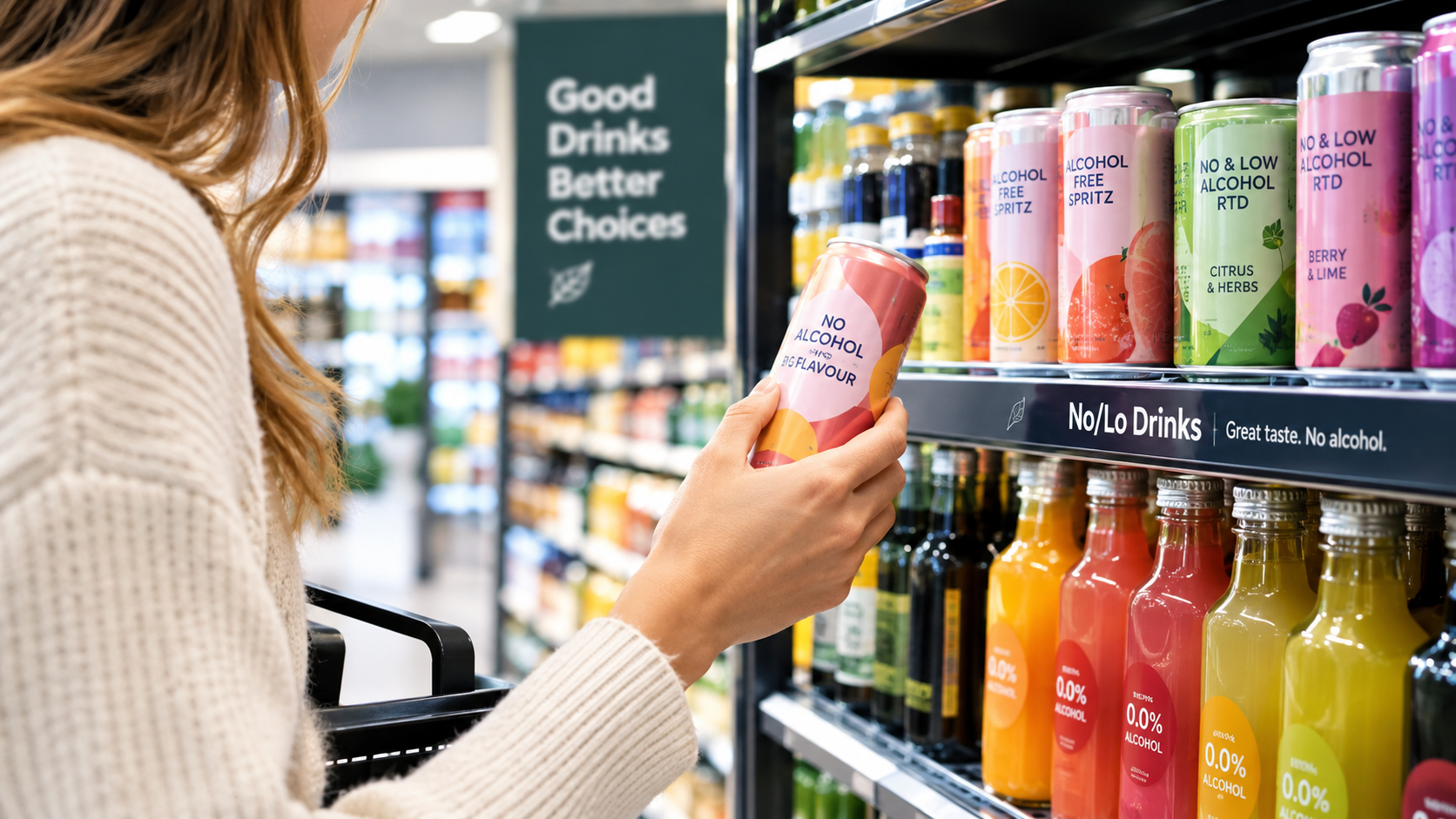
Walk into a UK supermarket today and something is noticeably different from five years ago. The alcohol aisle has a new neighbour -- and it's growing faster. Alcohol-free beer, botanical spirits, premium RTD mocktails and sparkling no-alcohol wines are no longer squeezed onto a half-shelf between the mixers and the cordials. They're getting dedicated fixtures, blue signage, and in some stores, more shelf space than craft beer used to command.
This isn't a January fad. It's a structural change in how British people drink -- and how they shop for drinks. The retailers and brands that figured that out early are pulling ahead. The ones still treating no/low as a niche are already behind.
1. The Numbers: How Big Is This Category Really?
Let's start with the scale, because it's bigger than most retailers think.
The UK's no and low-alcohol drinks market was worth around £380 million in 2024, according to Mintel estimates, and is forecast to hit £592 million by 2029 -- a jump of 55.7% in five years (IWSR/Treatt, 2025). Volume sales are expected to grow by 41.5% in the same period, reaching 149 million litres.
Beer is leading the charge. According to the British Beer and Pub Association (BBPA), 2025 was a record year for low and no-alcohol beer, with 200 million pints sold -- up nearly 20% on 2024. That figure now accounts for 2.7% of the UK's total beer market, a share that would have seemed outlandish a decade ago.
| Metric | Figure | Source |
|---|---|---|
| UK no/lo market value (2024) | £380m | Mintel / IWSR |
| Projected market value (2029) | £592m | IWSR / Treatt |
| Volume growth forecast (2024-2029) | +41.5% | IWSR |
| No/lo beer sold in 2025 | 200 million pints | BBPA |
| Year-on-year growth (beer) | +20% | BBPA / IWSR |
| No-alc beer's share of UK beer market | 2.7% | BBPA, Dec 2025 |
| Majestic no/lo sales increase since 2022 | +600% | Majestic Wines |
| Waitrose no/lo sales growth (summer 2025) | +32% | Waitrose |
| Drinkaware: adults who've tried no/lo (2025) | 45% | Drinkaware Monitor 2025 |
That last figure deserves a pause. Nearly half of UK adults have now tried a no or low-alcohol drink -- up from just 22% in 2021 (Drinkaware, 2025). That's not a niche. That's a mainstream category that's been hiding in plain sight.
UK No/Low Alcohol Market Value 2019-2029 -- IWSR / Treatt, 2025
No-alcohol beer volume growth (indexed, 2021-2025):
2021  ██████████                  (22% adults tried no/lo)
2022  █████████████               (steady growth, volume up 47% 2022-23)
2023  █████████████████           (low-alc volumes almost doubled)
2024  ████████████████████████    (beer +20% YoY, market £380m)
2025  ████████████████████████████ (200m pints, 45% adults tried no/lo)
Source: BBPA, IWSR, Drinkaware Monitor 2025
2. This Isn't Dry January Anymore
The old mental model for no/low was simple: Dry January drives a spike, February it collapses, and by March nobody's talking about it. That model is broken.
The Drinkaware Monitor 2026 -- their most comprehensive annual survey of UK drinking habits -- found that a record 91% of drinkers (around 42 million people) now use at least one technique to moderate their alcohol consumption, up from 87% in 2025. Nearly half of drinkers (48%) are using no/low alternatives as part of that moderation, up from 44% in 2025.
Lucky Saint founder Luke Boase put it plainly at the end of 2025: "We're seeing record sales with more people buying Lucky Saint than ever before. We're seeing this across every month of the year -- it's become ingrained as part of how people are drinking."
That's the key phrase. Not "part of January." Every month of the year.
And yet, January 2026 actually saw a slowdown in no/lo beer specifically -- value sales were up just 2.8% year on year to £17.1m (NIQ, 4 w/e January 2026) -- because demand had shifted toward functional soft drinks in January rather than no/lo beer. The moderation was still there. The form it took had just evolved. That's a category maturing, not struggling.
The Portman Group's 2026 YouGov survey found that more than one in three UK adults who drink alcohol (36%) now consume low and no-alcohol products either regularly or occasionally. Among 18-24 year olds, that figure rises to 43%.
Key insight for retail leaders: Moderation has moved from a January resolution to a year-round behaviour. If your no/lo range only gets a January display and then goes back to a half-shelf, you're leaving money on the table for eleven months of the year.
3. Who Is the No/Lo Shopper?
Understanding who's buying no/lo drinks matters enormously for where you stock them, how you market them, and how you price them.
The beer-first picture: Millennials are the backbone of no/lo beer consumption, making up 61% of consumers, with Gen Z at 17% (Impossibrew research, 2025). But the audience is broadening. The Drinkaware 2026 survey showed the category is no longer primarily driven by any single age group.
The affluence signal: IWSR data shows UK no/lo buyers are skewed toward higher earners. In 2025, 48% of ABC1 social grade adults reported moderating with alcohol-free or low-alcohol products, compared with 40% in the C2DE group -- a gap that has widened significantly from 2018, when there was barely any difference between the two groups (Drinkaware research, 2024).
The Gen Z factor: Gen Z's relationship with alcohol is genuinely different. Mintel research found that British consumers aged 20-24 are almost half as likely to prioritise spending on alcoholic drinks for the home compared to consumers aged over 75. Almost a third of young people say they choose low and no-alcohol drinks partly because they're cheaper than the alcoholic versions.
The gender split: IWSR data shows an even gender split among no/lo buyers -- though it's worth noting that 77% of GLP-1 weight loss drug users (a growing demographic actively reducing their consumption of alcohol, sugar and processed food) are women, creating a significant overlap with no/lo buyers (Worldpanel by Numerator, 2026).
| Shopper Segment | Key Behaviour | Implication for Retail |
|---|---|---|
| Millennials (61% of no/lo beer buyers) | Drinking less, drinking better | Premium placement, not value section |
| Gen Z (18-24s) | Sober-curious, experience-led | Occasion merchandising, social media-ready packaging |
| ABC1 adults | Higher spend, quality-conscious | Curated range, not just budget AF options |
| GLP-1 users (6.3% of UK households in 2026) | Actively reducing alcohol alongside sugar/snack reduction | Pair with functional food, signpost clearly |
| Religious/cultural abstainers | Non-occasional, permanent buyers | Year-round ranging commitment needed |
4. The Format Breakdown: Beer Leads, But the Rest Is Catching Up
Beer is the undisputed star of no/lo -- but that's partly a story about head start rather than permanent dominance.
Beer: No-alcohol beer now accounts for more than 2% of total beverage alcohol market sales in the UK (IWSR, Jan 2025). Guinness 0.0 is the category's biggest commercial success, with sales up 41.3% to £48.4 million in the 52 weeks to August 2025 (NIQ). Lucky Saint, despite still operating at a loss while investing in growth, hit revenues of £21.7 million in the 18 months to June 2025 -- a 126% rise on the prior 12-month period (Companies House / The Grocer, 2026). Athletic Brewing, Heineken 0.0, BrewDog AF and Kronenbourg have all expanded their non-alcoholic NPD in recent years.
Wine: No-alcohol wine grew +8% in 2024 vs 2023, while low-alcohol wine fell -5% in the same period (IWSR, Jan 2025). The lesson: consumers want either full commitment to flavour or none at all. Half-measures (literally) aren't landing.
Spirits and RTDs: This is where the white space sits. Alcohol-free beers grew 38% and alcohol-free cocktails 27% in the UK drinks market in 2025 (Lumina Intelligence). Non-alcoholic spirits like Seedlip, Lyre's (which took the No. 1 non-alcoholic spirits slot in Drinks International's 2024 Brands Report), CleanCo and Three Spirit are building genuine consumer bases. Pernod Ricard launched Beefeater 0.0 across UK pubs from September 2025. The RTD mocktail segment globally is projected to grow at a CAGR of 10.4% from 2026 to 2034 (MarketIntelo, 2025).
Across all formats, the picture is the same: consumers want choice, and they want it to feel premium, not apologetic.
| Format | 2024/25 Performance | Leading Brands | Opportunity Rating |
|---|---|---|---|
| No-alcohol beer | +20% YoY, 200m pints (2025) | Guinness 0.0, Lucky Saint, Heineken 0.0, Athletic Brewing | Already mainstream -- execution matters |
| No-alcohol wine | +8% (2024 vs 2023) | Noughty, Eisberg, Torres Natureo | Growing but fragmented |
| No-alcohol spirits | Strong growth, 26.8% of mocktail market | Seedlip, Lyre's, CleanCo, Beefeater 0.0 | High potential, early stage |
| RTD mocktails / functional drinks | +27% (AF cocktails), CAGR 10.4% forecast | Fever-Tree, Lyre's RTD, Dash Water | Biggest white space for mid-market |
| Sparkling botanicals / adaptogen drinks | Rapid early growth | Three Spirit, Everleaf, Aqua Libra | Emerging -- premium opportunity |
| Alcohol-free lager | Accounts for 23% of AF purchases | Guinness 0.0, Heineken 0.0 | Most accessible entry point for mainstream shoppers |
5. Brand Spotlight: What's Actually Winning and Why
The brands succeeding in this category share a few things in common. They don't apologise for not having alcohol. They compete on taste, design and occasion. And they've worked hard to earn shelf space rather than just asking for it.
Guinness 0.0 is the category's commercial king. At £48.4m in UK off-trade sales (NIQ, August 2025) and growing 41.3% year on year, it's the most valuable beer and cider brand in the no/lo space. The power of the Guinness brand -- and the willingness of Diageo to back it with serious marketing -- has done more to normalise no-alcohol stout than any campaign could. Consumers who would never have reached for an unknown alcohol-free brand will happily pick up Guinness 0.0.
Lucky Saint is the challenger doing it the hard way. Founded in 2018 with one product, it's now in major UK supermarkets, over 1,000 pubs on draught, and running its own pub in central London. Revenue hit £21.7m in the 18 months to June 2025. The brand's philosophy -- that the best part of drinking is the social connection, not the alcohol -- has resonated in a way that "diet beer" never did. It won Which?'s 2025 blind taste test.
Seedlip (owned by Diageo) pioneered the non-alcoholic spirits category and remains the benchmark. Its three variants (Garden 108, Spice 94, Grove 42) are designed to be mixed with tonic -- and have created a whole sub-category of premium no-alcohol serves for bars and homes.
Lyre's took the No. 1 non-alcoholic spirits slot in Drinks International's 2024 Brand Report. Its RTD formats are expanding shelf presence and are increasingly available in UK supermarkets.
Athletic Brewing brings a craft beer credibility that resonates with the health-conscious, gym-going consumer segment. Its US origins and premium positioning have helped build a loyal UK following.
What the winners have in common: They invest in taste first, then design, then occasion. They don't rely on the "free from" message alone. And they build communities, not just products.
6. What UK Supermarkets Are Actually Doing About It
The major UK grocers have moved significantly on no/lo -- but not evenly.
Waitrose has arguably made the clearest strategic commitment. Working with Diageo, it introduced dedicated alcohol-free areas -- marked with blue signage -- across 253 stores, giving the booze-free category 60% more space (Beveragedaily/Waitrose, 2023). Its no/lo range now covers 70+ products across beer, cider, wine and spirits. Sales grew 20% year on year in the period, with summer 2025 seeing a further surge of 32%. The lesson Waitrose offers other retailers is simple: a curated, well-signed, dedicated fixture sells more than an awkward shelf between lager and water.
Sainsbury's has significantly expanded its alcohol-free range, including adding dedicated online sections. Its own-brand alcohol-free sparkling and red wines have received strong reviews. Around 54% of consumers turn to supermarkets to discover new no/lo drinks -- versus just 24% who try a new product in a bar first (survey data). That puts grocers at the top of the discovery funnel, and Sainsbury's is investing accordingly.
Tesco, as the UK's biggest supermarket, has been expanding its no/lo offer and was an early mover in the category, aiming to "set the gold standard on low/no choice within grocery" as far back as 2017. Its Clubcard price architecture gives it a strong tool to drive trial at scale.
Morrisons has leaned into "adult soft drinks" as a category framing -- a smart signal that their merchandising team understands the positioning challenge: these aren't children's drinks, they're grown-up choices.
The picture across all major grocers: range is improving, but execution is inconsistent. Too many stores still stock no/lo beer in the main beer section but leave no/lo spirits and wines scattered. A shopper looking for an alcohol-free aperitif shouldn't have to hunt.
Retailer No/Lo Commitment Comparison
| Retailer | Dedicated Section | Own-Label | Spirits Range | Space Given | Trend |
|---|---|---|---|---|---|
| Waitrose | Yes (253 stores) | Yes | Seedlip, Tanqueray 0.0, Beefeater 0.0 | +60% dedicated space | Leading |
| Sainsbury's | Online + expanding in-store | Yes (sparkling wine, spirits) | Growing | Significant | Strong |
| Tesco | Expanding | Limited | Gordon's 0.0, Heineken 0.0 | Growing | Good |
| Ocado | Strong online | Limited | Widest online wine selection | Premium curated | Excellent online |
| Morrisons | "Adult soft drinks" section | Limited | Limited | Moderate | Improving |
| Asda | Expanding | Limited | Ceder's | Moderate | Catching up |
7. The RTD Opportunity: Where the Real White Space Is
Here's the part most UK retailers are missing.
The RTD category -- ready-to-drink, single-serve, premium, occasions-led -- is where the next wave of growth is building. Not in another can of no-alcohol lager, but in something that doesn't feel like a compromise at all.
Think about the occasions no/lo RTDs serve that beer doesn't: a dinner party where half the table isn't drinking but still wants something that feels celebratory. A picnic in June. A business lunch. An after-gym drink that doesn't undo the workout. These are high-value, high-frequency occasions where a sparkling botanical drink, a premium alcohol-free cocktail, or a functional RTD wins easily -- if it's stocked.
The RTD mocktail/premium no-alcohol segment held 38.5% of the global mocktail market in 2025 and the segment is projected to grow at a CAGR of 10.4% from 2026 to 2034 (MarketIntelo). Fever-Tree, Lyre's and a growing roster of independent UK brands are all expanding into this space.
Functional RTDs -- drinks that contain adaptogens, nootropics, electrolytes, or gut-health ingredients alongside their alcohol-free credentials -- are the next frontier. Brands like Three Spirit, Blynk Drinks (mushroom-based functional beverages), and Impossibrew (which adds relaxation ingredients) are early movers. For context on how fast a well-positioned RTD brand can move in the UK, read our breakdown of AU Vodka vs Diageo and how it beat Gordon's in UK RTD sales -- the same velocity is now showing up on the no-alcohol side.
The merchandising problem: Most UK retailers still stock functional RTDs and sparkling botanicals in the soft drinks aisle, away from the no/lo fixture. That positioning communicates the wrong thing -- these aren't alternatives to Ribena, they're alternatives to a gin and tonic. Moving them to the no/lo fixture, or creating occasion-led displays, would likely shift significant volume.
Key insight for retail leaders: If your no/lo section is only stocked with beer and a couple of wines, you're serving a fraction of the occasions that the category can win. RTDs and botanical spirits are the growth engine -- and they're currently undershelved in most UK stores.
8. The Price Barrier: Real, But Overestimated
One thing holds the category back more than any product failing: price.
53% of all UK adults cite cost as a reason for not drinking no/lo options more often -- and crucially, 45% of consumers in a stronger financial position are also put off by price (IWSR/Treatt, 2025). This isn't just a budget shopper problem. Even people who can afford premium alcohol hesitate at premium no-alcohol pricing.
The paradox is that many alcohol-free products actually cost more to produce than their alcoholic equivalents -- the dealcoholisation process, the specialist ingredients, the smaller production runs all add cost. Brands like Lucky Saint have been open about the fact that their economics at scale are harder than Guinness's, which is why their per-unit price is higher.
But there are ways to manage this for shoppers:
- Multipack pricing -- the most effective tool. No/lo beer in a 12-pack normalises the category and brings the per-unit cost down.
- Meal deal inclusion -- adding a no/lo drink to an evening meal deal drives trial without requiring a standalone purchase decision.
- Own-label no/lo -- still underdeveloped. Most supermarkets have strong own-label in almost every drinks category except no/lo. There's a clear opportunity to build credible own-label AF beer and wine at accessible price points.
- Clubcard / loyalty pricing -- Tesco's tool is particularly well-suited to driving trial in new categories.
For brands navigating the ranging and pricing conversation with buyers, the principles are similar to any emerging category. Our guide on range review preparation for UK FMCG brands covers how to build the data case for new category investment.
9. The Regulatory Shift That Could Change Everything
There's a piece of policy working its way through government that no one in the drinks trade should ignore.
Currently, the UK defines "alcohol-free" as containing 0.05% ABV or less -- the strictest definition in the world. Almost every other country, including across the EU, uses 0.5% ABV as the alcohol-free threshold. This one regulatory quirk is holding the UK back in two significant ways.
First, it's creating a two-tier production problem. Lucky Saint brews its beer in Germany specifically because, under UK law, if it were produced domestically it would need to be below 0.05% ABV to carry the "alcohol-free" label -- whereas in the EU the limit is 0.5%. British brands competing on a global scale are disadvantaged before they've even started.
Second, it's limiting consumer clarity. The UK currently has four different voluntary descriptors: "low alcohol", "non-alcoholic", "alcohol free" and "de-alcoholised" -- none of which are legally mandated. Around 10% of beers marketed as "alcohol-free" in the UK actually contain up to 0.5% ABV, because the labelling rules are voluntary (Unhopped, 2026). That's confusing for consumers, particularly those choosing no/lo for religious reasons or during pregnancy.
The UK government's 10-Year Health Plan for England (July 2025) committed to consulting on raising the alcohol-free threshold to 0.5% ABV, aligning with international standards. If and when that change happens, it would:
- Unlock new product development from UK brewers currently unable to compete on labelling
- Simplify consumer communication
- Potentially open up age-restriction reviews for sub-0.5% products
- Bring significant fresh investment into the UK no/lo sector
The BBPA, the Portman Group (backed by Diageo, Heineken, Bacardi, Molson Coors and Lucky Saint), and individual brands have all lobbied hard for the change. Two previous consultations (2018 and 2023) were launched but not concluded before elections. Whether the third time proves different remains to be seen -- but it's a genuine tailwind for the category if it comes through.
For retailers and brands: Don't wait for the regulation. Build range depth now based on where the category is heading, not where labelling law currently sits.
10. What Mid-Market Retailers Are Getting Wrong
Most of the strategic errors in no/lo aren't about product choice. They're about mindset.
Mistake 1: Treating it as a health-only category. No/lo isn't primarily a health category. It's a social category. The biggest driver isn't "I want to be healthy" -- it's "I want to be part of the occasion without the hangover." Ranging it in the free-from aisle, or positioning it purely against "good health" messaging, misses the real purchase trigger. It belongs in the drinks aisle, full stop.
Mistake 2: Seasonal ranging. Expanding no/lo for January and contracting it for the rest of the year is now the wrong play. As Lucky Saint's data shows, this is a year-round purchase. The moderation trend doesn't hibernate in February.
Mistake 3: Stocking only the obvious. Guinness 0.0 and Heineken 0.0 are important. But a shopper who's tried both and wants something different is currently being failed by most UK stores. The lack of botanical spirits, premium RTDs, and high-quality no-alcohol wines on the standard range means you're not capitalising on a higher-spending, more curious customer.
Mistake 4: Poor in-store navigation. Seven in ten UK adults say they want to be able to find low alcohol and alcohol-free drinks more easily (Diageo consumer research). If a shopper has to check three aisles to assemble a no/lo drinks order, you've already lost them to Ocado or a specialist website. Dedicated sections work. Waitrose proved it.
Mistake 5: Ignoring the on-trade signal. On-premise no/lo beer sales rose 26.4% in 2025 after a 22% increase in 2024 (Impossibrew research). Pubs are stocking this because their customers are asking for it at the bar. The consumer who chooses Guinness 0.0 at the pub on Thursday is looking for something similar in Sainsbury's on Saturday. Off-trade and on-trade are feeding the same habit.
For a broader look at how fast-growing challenger brands are building distribution in these emerging drinks categories, see our analysis of how AU Vodka's £500m exit shows that going viral is a supply problem first -- the same lesson applies to any no/lo brand hitting sudden scale.
11. Key Lessons for UK Retail and FMCG Leaders
Lesson 1: The Category Has Crossed the Tipping Point
When nearly half of UK adults have tried no/lo drinks and 91% of drinkers are actively moderating, this is no longer an emerging category. It's established. The brands and retailers still positioning it as "niche health" are operating with a mental model that's at least three years out of date.
Ask yourself: Is our no/lo range sized and positioned for a category that 45% of adults have tried, or one that only 10% have?
Lesson 2: Taste Won the Argument -- Now Execution Needs to Catch Up
The product quality problem that defined early no/lo (watery beer, flat wine, uninspiring flavour) has largely been solved by the leading brands. Guinness 0.0 outsells original Guinness in some accounts. Lucky Saint won the Which? blind taste test. The consumer objection is no longer "it doesn't taste good enough." It's "I can't find it when I want it" or "it's too expensive."
Ask yourself: Are we solving a product problem that no longer exists, while ignoring the ranging and pricing problems that do?
Lesson 3: The RTD Opportunity Is Being Left on the Table
Functional RTDs and premium sparkling no-alcohol drinks are the fastest-growing segment within no/lo -- and the most undershelved in most UK stores. Mid-market retailers who move to build range depth in this sub-category now will have first-mover advantage before the big players fully commit.
Ask yourself: What does our no/lo offering look like for a dinner party host who wants four different formats for four guests who aren't drinking that evening?
Lesson 4: Shelf Positioning Is a Commercial Decision
Where you put no/lo matters. Tucked at the end of the beer section -- or worse, with the soft drinks -- communicates "this is the second choice." Dedicated sections with clear signage and curated ranging communicate "this is a genuine category." Waitrose gave it 60% more space and saw sales jump 20%. That's a return on shelf investment any grocery buyer should want to model.
Actionable Recommendations
For Retail Business Owners and Category Managers
- Audit your no/lo fixture right now. If you can't quickly find an alcohol-free spirit, a premium RTD mocktail, and at least two no-alcohol wine options, your range has a gap.
- Move no/lo out of the seasonal mindset. Build a year-round planogram, not a January-only one.
- Consider a dedicated no/lo section with clear blue or distinct signage -- the Waitrose model is proven. Even a small investment in navigation pays dividends.
- Build occasion-based merchandising around no/lo -- dinner party, everyday moderation, gym recovery -- rather than health-only messaging.
- Review your own-label no/lo opportunity. It's one of the few categories where own-brand is underdeveloped relative to demand.
For B2B Leaders and Brands Supplying into Retail
- Lead with data when building the JBP case. The NIQ, BBPA, and IWSR figures cited in this article are the kind of category data that moves buyer conversations. Our mid-market FMCG guide to winning JBP season covers exactly how to frame this.
- Position your no/lo products as occasion plays, not health plays. Buyers respond to incremental basket, not wellness credentials.
- Don't wait for the 0.5% ABV regulatory change to expand your range -- but do build your planning around it. It's coming.
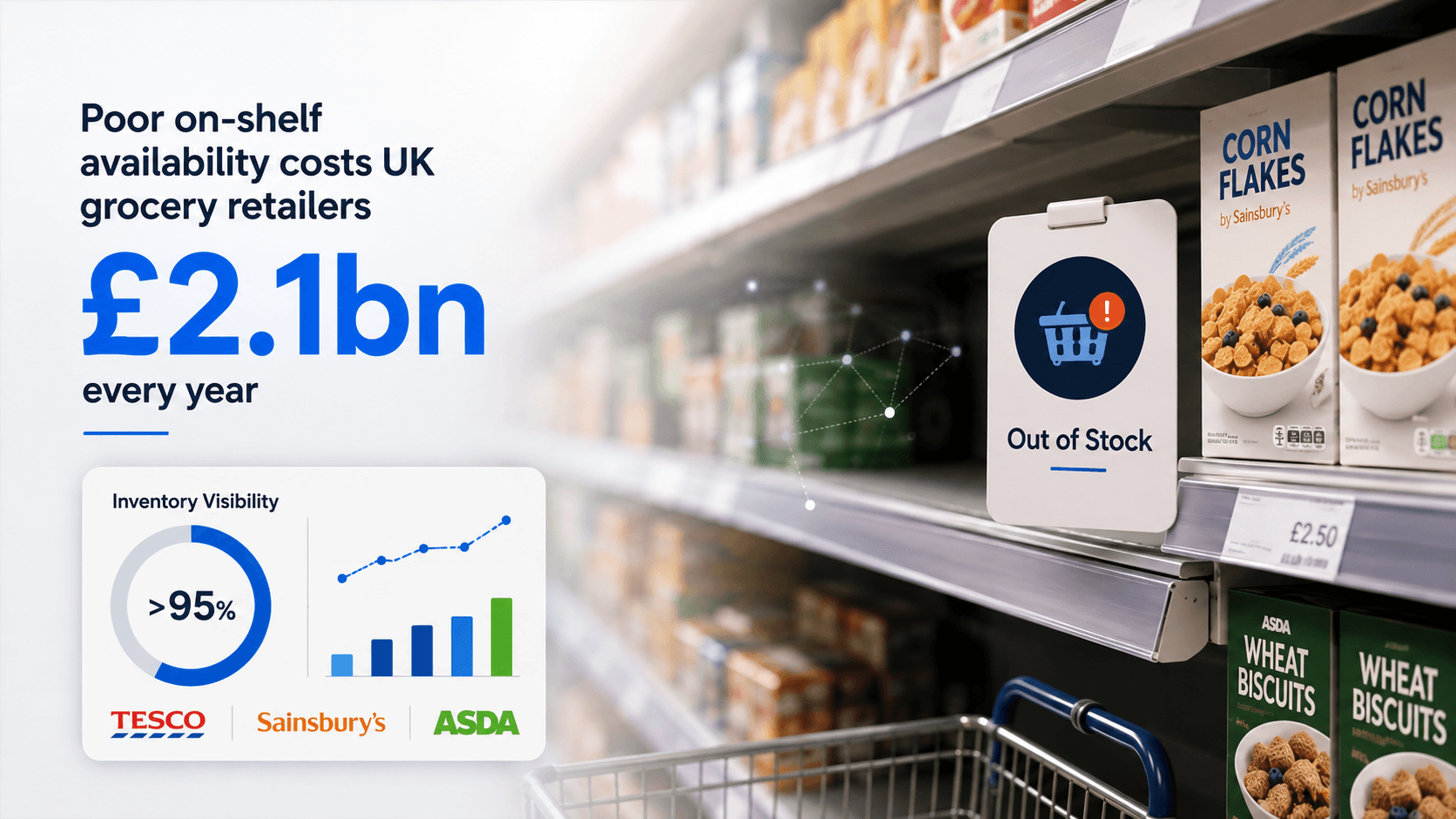
- On-shelf availability is as important as winning the listing. A no/lo brand that keeps going out of stock is training shoppers to go elsewhere. Our piece on on-shelf availability in UK grocery covers the execution discipline this requires.
- Invest in sampling and trial. 54% of consumers discover new no/lo products in the supermarket -- which means the store is your best marketing channel.
For Drinks Brands Considering Entering the No/Lo Space
- Flavour first, format second. The biggest barrier to repeat purchase isn't awareness, it's taste disappointment on first try.
- Premium positioning is more defensible than value. The no/lo consumer is spending more per unit, not less, and they expect the product to meet that bar.
- Get the distribution right before scaling marketing. As we examined in TrueStart's RTD coffee retail strategy, being viral without supply chain readiness creates more problems than it solves.
Final Summary
| Challenge | What's Happening | What Retailers Should Do |
|---|---|---|
| Category positioning | No/lo is still treated as niche or health-only in many stores | Move it mainstream -- dedicated sections, year-round ranging |
| Range depth | Beer dominates; RTDs, botanicals and wine are underdeveloped | Expand beyond beer into spirits, RTDs and premium formats |
| Price barrier | 53% of adults cite cost as the main deterrent | Multipacks, loyalty pricing, own-label investment |
| In-store navigation | 70% of adults struggle to find no/lo easily | Dedicated fixtures, clear signage, occasion-based displays |
| Regulatory lag | UK's 0.05% ABV definition restricts growth | Plan for 0.5% change -- it's in the government's Health Plan |
| RTD white space | Functional and premium RTDs are undershelved | Identify and list 3-5 RTD/botanical brands now |
| Seasonality trap | Many retailers still treat it as a January category | Year-round planogram; no/lo is a permanent fixture now |
Frequently Asked Questions
What is the difference between alcohol-free and low-alcohol drinks in the UK?
In the UK, "alcohol-free" currently means a drink containing 0.05% ABV or less -- one of the strictest thresholds in the world. "Low alcohol" covers drinks up to 1.2% ABV. Most other countries use 0.5% ABV as the alcohol-free threshold, and the UK government's 10-Year Health Plan (2025) has committed to consulting on aligning with this international standard. Until that change happens, some drinks sold as "alcohol-free" in the UK may contain up to 0.5% ABV as the labelling guidance is voluntary, not legally binding.
How big is the UK alcohol-free drinks market in 2025?
Mintel estimated the total UK no and low-alcohol market at around £413m in 2025. The British Beer and Pub Association reported a record 200 million pints of low and no-alcohol beer sold in 2025 -- a 20% increase on 2024. The market is forecast to reach £592m by 2029, according to IWSR.
Are alcohol-free drinks popular with younger consumers in the UK?
Yes, significantly. 43% of 18-24 year olds consume no/low alcohol products semi-regularly (Portman Group/YouGov, 2026). Gen Z are also more likely to identify with the sober-curious movement, choosing to drink less for health, financial and lifestyle reasons. However, Millennials actually make up the largest share of no/lo beer buyers (61%), with Gen Z at 17%.
Why are some alcohol-free drinks more expensive than regular ones?
Several factors drive the higher price: the dealcoholisation process (removing alcohol from fermented drinks is technically complex and costly), smaller production runs, premium ingredients, and the packaging and marketing investment required to build a new category. As production volumes scale and competition grows, prices are expected to come down -- but for now, cost remains the single biggest stated barrier to purchase.
Which UK supermarket has the best alcohol-free drinks range?
It depends on format. Ocado leads for premium selection -- particularly wines. Waitrose has made the most visible structural commitment, dedicating 60% more shelf space to no/lo in 253 stores with dedicated blue-signposted sections. Sainsbury's has strong beer selection and a dedicated online no/lo category. Tesco offers the widest accessibility, given its store count. For specialist and independent no/lo brands, specialist online retailers like The Alcohol-Free Co and Dry Drinker often outperform any supermarket.
What RTD alcohol-free drinks are growing fastest in the UK?
Alcohol-free cocktails grew 27% in the UK drinks market in 2025 (Lumina Intelligence). Globally, the RTD mocktail segment is projected to grow at a CAGR of 10.4% through to 2034. Key brands in the UK include Lyre's (No. 1 non-alcoholic spirits brand, Drinks International 2024), Fever-Tree's no-alcohol serve range, Three Spirit (adaptogen-based drinks), and a growing roster of botanical sparkling drinks. Functional RTDs combining health ingredients with great taste are the fastest-emerging sub-segment.
What does the UK government's 10-Year Health Plan mean for alcohol-free drinks?
Published in July 2025, the government's 10-Year Health Plan committed to consulting on raising the UK's alcohol-free threshold from 0.05% ABV to 0.5% ABV -- bringing it in line with most international markets. If adopted, this would allow UK brewers to produce drinks currently only manufactured abroad (like Lucky Saint, brewed in Germany) domestically under an alcohol-free label. It would also simplify consumer labelling and is expected to unlock significant new investment in the category.
How can FMCG brands win more shelf space for their no/lo products?
The most effective approach is building a clear category data story -- showing incremental basket value, category growth rates, and which shopper occasions your product uniquely serves. Buyers are under pressure to grow categories, not just swap one brand for another. Positioning your no/lo product as bringing in new shoppers (rather than cannibalising existing no/lo sales) is the strongest argument. Read our range review preparation guide for UK FMCG brands for a full breakdown of the data pack approach.
Grow Your Business With Integrated Data and Operational Intelligence
The no/lo category is one of the clearest examples in UK FMCG of a structural consumer shift that's outpacing the speed at which most retailers and brands are responding. The data is unambiguous. The consumer behaviour is durable. The only question is how quickly your commercial strategy catches up.
At GrowSights, we work with mid-market retail operators and FMCG brands who want sharper answers to exactly these kinds of category questions -- not in months, but in weeks. Whether you're trying to build a category case for your buyer, identify the right RTD brands to range, or understand where your no/lo execution is losing you sales, our diagnostic approach gets to the answer faster than the conventional route. Find out how we work or take a look at who we work with.
If this is the kind of challenge you're working through right now, start a conversation with us.
Research sources: British Beer and Pub Association (BBPA), December 2025 | IWSR / Treatt Low and No Alcohol Market Report 2025 | Mintel UK Attitudes Towards Low and No Alcohol Drinks 2025 | NIQ UK FMCG Data (various, 2025-2026) | Drinkaware Monitor 2026 | Portman Group / YouGov Survey 2026 | Worldpanel by Numerator (GLP-1 data, 2026) | The Grocer (Lucky Saint financials, Guinness 0.0 sales data, 2025-2026) | Lumina Intelligence UK Drinks Market 2025 | Beveragedaily.com (Waitrose, regulatory data) | Drinks International Brand Report 2024 | UK Government 10-Year Health Plan for England (July 2025) | Companies House (Lucky Saint accounts) | MarketIntelo Mocktails Market Report 2025 | Impossibrew / non-alcoholic beer trend research 2025
Published by GrowSights | Retail Intelligence and Growth Engineering | Point of View