Budget 2026: Retail Costs Are Rising. So Who Absorbs the Bill?
The Budget gave grocery retailers some relief and some new costs. For FMCG suppliers, the real test comes in the trading conversation that follows.
Costs don't disappear. They move.
When a supermarket's wage bill, rates bill or energy bill goes up, somebody has to pay for it. It might be the retailer, through a thinner margin. It might be the shopper, through a higher price. Or it might be the supplier, through a tougher conversation about price, promotional funding and trading terms.
Yesterday's UK Budget (28 October) gave grocery retailers and FMCG suppliers a mixed set of signals. Some costs eased. Others rose. And the industry's reaction was anything but united.
Here's what was confirmed, what it could mean for suppliers, and what to do now. Where something is our view rather than sourced fact, we say so.
1. Budget Day at a Glance: What Was Confirmed
First, the facts. These are the Budget results that matter most to grocery retailers and FMCG suppliers.
| Measure | What was confirmed | When it starts | Source |
|---|---|---|---|
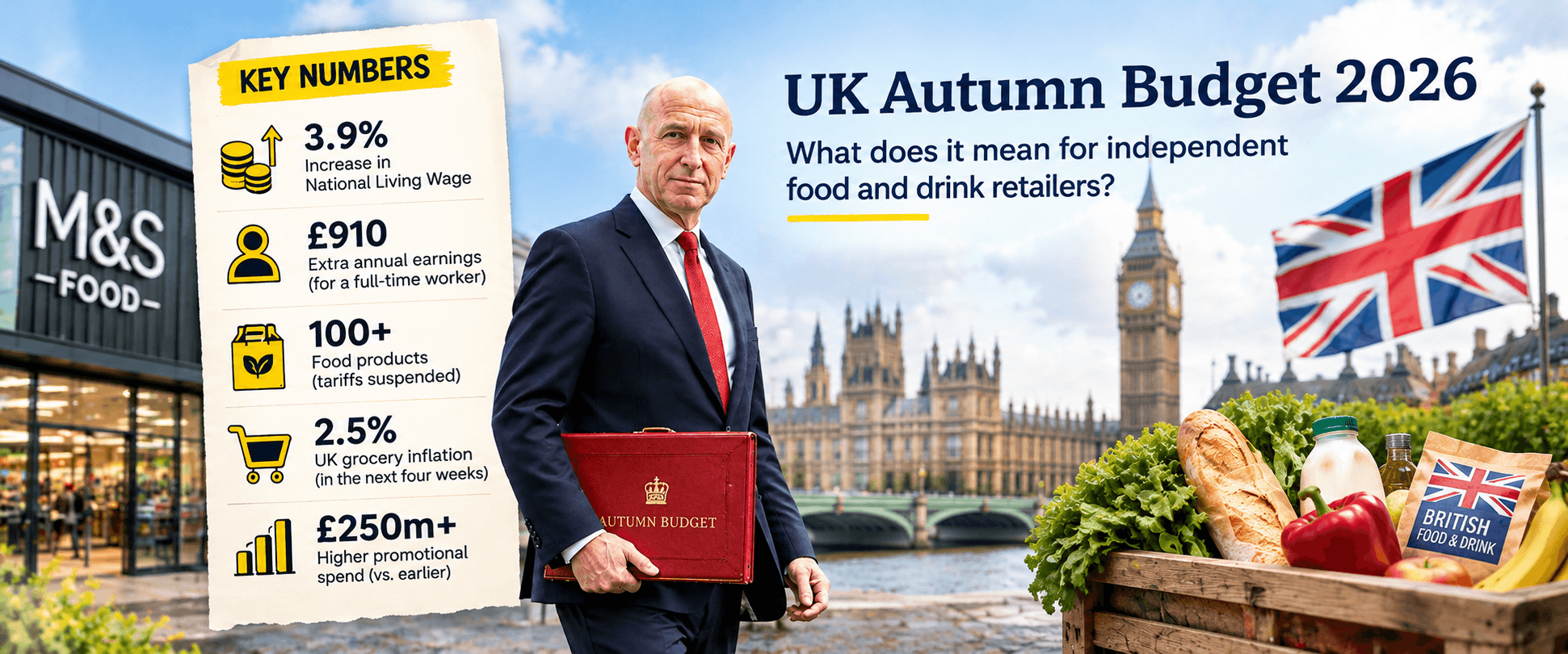
| National Living Wage (21 and over) | Up 3.9%, from £12.71 to £13.21 an hour | 1 April 2027 | Retail Insight Network, Personnel Today |
| Wage rate for ages 18 to 20 | Up 3.9% to £11.27 an hour | 1 April 2027 | Retail Insight Network |
| Extra pay for a full-time worker on the minimum | About £910 a year in gross earnings | 1 April 2027 | Retail Gazette |
| Business rates relief | Threshold for 100% relief rises from £12,000 to £18,000 for qualifying retail, hospitality and leisure properties in England | April 2027 | Retail Insight Network |
| Business rates bills | Frozen in real terms for two years for qualifying properties | 2027-28 and 2028-29 | Retail Insight Network, FPC Fresh Talk Daily |
| Import tariffs | Suspended on more than 100 food and everyday products | Announced just before and during the Budget | Brit Brief, FPC Fresh Talk Daily |
| Fuel duty | 5p cut extended; planned increase deferred until July 2027 | Ongoing | Retail Gazette, FPC Fresh Talk Daily |
| Employer National Insurance | Rates unchanged | n/a | Retail Insight Network |
| Online marketplace VAT | Marketplaces to collect VAT on qualifying sales | October 2027 | Retail Insight Network |
The wage rise lands everywhere. The rates relief only helps qualifying properties. That gap is the heart of the story.
2. What the Budget Means for Retailers: Relief and Frustration at the Same Time
Let's start with the retail reaction, because it tells you a lot about where pressure is likely to build.
Independent retailers were pleased. The British Independent Retailers Association (Bira) described the business rates changes as "a real win for independent retailers." The Association of Convenience Stores (ACS) welcomed the higher threshold too, noting that thousands of small shops will pay no rates at all. According to the government's expectation, reported by Retail Insight Network, the changes will take around 70,000 additional high-street businesses out of business rates.
The British Retail Consortium (BRC) saw it very differently. Its chief executive, Helen Dickinson, called the rates announcement a "smoke and mirrors" move, arguing that freezing bills in real terms still means a 3.5% increase. The BRC says that will add around £250m to retailers' bills next April, with one in seven shops already empty.
So who's right? Probably both, for different shops. It depends on what you run.
This matters for suppliers because retailers aren't one customer. Your convenience accounts, your multiples and your discounters will all be feeling different parts of this Budget. Treating them as a single conversation is a mistake.
3. The Wage Rise in Context: National Living Wage 2027
The headline number is simple. From April 2027, the National Living Wage rises 3.9% to £13.21 an hour. The government says this will affect around 2.3 million people.
That's slower than some recent increases, and trade bodies noticed. The ACS welcomed the more moderate rise ahead of the Budget, according to Better Retailing. But "more moderate" isn't the same as "small," and the numbers add up.
| Wage milestone | Rate | Source |
|---|---|---|
| National Living Wage, 2020 | £8.21 | Personnel Today (UHY Hacker Young) |
| National Living Wage, April 2026 | £12.71 | Retail Insight Network |
| National Living Wage, April 2027 | £13.21 | Retail Insight Network |
| Rate for ages 18 to 20, April 2027 | £11.27 | Retail Insight Network |
| Additional gross annual pay, full-time minimum wage worker | About £910 | Retail Gazette |
UHY Hacker Young pointed out that the rate will have risen 61% between 2020 and April 2027. That's a long run of increases for labour-intensive businesses, and grocery retail is one of them.
The BRC puts a number on it. It estimates the Budget will add £2bn to retail employment costs, on top of £6.5bn over the previous two years. It also notes that employer National Insurance contributions were not reduced. Retail Insight Network confirms employer NI rates stay unchanged.
Here's our view, and it's only a view: wages are the cost retailers can't negotiate with anyone. Rates, energy and rent have some room for appeals, deals and hedging. A statutory wage rate has none. That makes the pay bill the cost most likely to push retailers toward looking at everything else in their margin, including supplier terms.
Key insight for retail leaders: Wage costs are fixed by law, so the room to manage them sits elsewhere in the P&L. That's why trading terms get attention when pay rises.
4. Business Rates: Who Actually Wins?
The business rates package is the part of the Budget most likely to be quoted as "support for retail." It's worth being precise about what it does.
| Change | Detail | Source |
|---|---|---|
| 100% relief threshold | Up from £12,000 to £18,000 | Retail Insight Network |
| Tapered relief threshold | Up from £15,000 to £21,000 | Retail Insight Network |
| Businesses taken out of rates | Around 70,000 additional high-street businesses (government expectation) | Retail Insight Network |
| Bills for qualifying properties | Frozen in real terms for two years, increases capped by CPI | Retail Insight Network |
| Who qualifies | Qualifying retail, hospitality and leisure properties in England | Retail Insight Network |
Two things to keep in mind. First, it's England only. Second, it targets smaller properties. A large supermarket or a big out-of-town store won't see the same benefit as a corner shop.
That's why the BRC and Bira can look at the same Budget and reach different conclusions. Both are describing real effects. They're just describing different shops.
For suppliers, the practical point is who your customers are. If a big share of your sales goes through independents and convenience stores, this part of the Budget could help your customers' finances. If you sell mainly through large grocers, the relief matters much less.
5. Tariffs: How Big Is This Really?
The tariff suspension on more than 100 food and everyday products got plenty of attention. The government says that, combined with earlier suspensions, households could save up to £21 a year on their food shop, which works out at around 40p a week.
The products named include baked beans, chocolate-coated wafers, garlic, gherkins, boiled sweets, plant-based drinks and marmalade. Imported marmalade, for example, currently carries a 20% tariff plus £19 per 100kg, according to the figures reported by GB News.
So is it a big deal? Opinion in the industry is divided.
| Voice | Their view (paraphrased) | Source |
|---|---|---|
| Government | Could save households up to £21 a year | AOL, Brit Brief |
| NFU | Almost 90% of UK food imports already enter duty-free, so most imports are unaffected | FPC Fresh Talk Daily |
| BRC | The cuts will do little to offset rising supermarket costs, even on the limited products covered | FPC Fresh Talk Daily |
| FDF | Removing tariffs will not meaningfully change consumer prices and could undermine British factories making the same products | FPC Fresh Talk Daily |
| Online reaction | Some shoppers questioned whether the saving was meaningful | GB News |
For suppliers, this one cuts both ways. If you import products or ingredients on the list, your costs could fall. If you manufacture in the UK and compete with imports of those products, the FDF's concern is yours. Either way, it's worth checking the official list line by line.
What we wouldn't do is assume that a tariff suspension turns into a lower price on shelf, or a better deal in your negotiation. The NFU makes the same point about pass-through: any saving depends on whether it travels through the supply chain.
6. Energy and Fuel: The Costs That Don't Show Up in the Headline
Energy rarely leads the Budget coverage, but it sits right under the supply chain.
The BRC says the retail industry's electricity costs are expected to rise by £440m this year despite almost no change in usage. It adds that non-commodity charges now make up around two-thirds of bills. It welcomed the future de-linking of gas and electricity prices, but said the Budget didn't go far enough. In particular, it wanted the British Industrial Competitiveness Scheme extended to retail and its supply chain.
On the transport side, the news is better. The 5p fuel duty cut is extended and the planned increase deferred until July 2027. Retail Gazette says that will be welcomed by retailers with large delivery fleets and by businesses that depend on road transport. The NFU, though, notes that fuel prices are 65% higher than a year ago, so it described the extension as offering minimal relief to farming businesses.
The Food and Drink Federation (FDF) was blunter about manufacturers. It said the Budget does nothing to address the acute pressures facing food and drink producers, and that very high energy costs and complex regulation are turning investment away from the sector.
If you supply a retailer whose electricity bill is rising and whose own supplier costs are rising too, you're in the middle of a squeeze. That's a hard place to negotiate from without evidence.
7. Budget Impact on Suppliers: Where Does the Pressure Go?
Here's the question in the title. Who ultimately absorbs the extra cost?
The honest answer is that nobody has volunteered. And the evidence from this year suggests that costs don't pass through cleanly in either direction.
Consider what the FDF has reported. In its Q4 2026 State of the Industry report, it said manufacturers had been unable to fully pass on costs because of intense retail competition and weak consumer demand. It also said Extended Producer Responsibility had added £1.1bn in costs to manufacturers. Confidence among food and drink manufacturers was -31% in Q2 2026, the ninth consecutive quarter of negative sentiment.
Now consider what Reuters reported in October. UK food inflation hasn't reached the levels forecast earlier in the year, reflecting fierce supermarket competition, shoppers' resistance to further price rises and better hedging in the industry.
Put those together. Retailers are competing hard on price. Shoppers are resisting increases. Manufacturers say they can't pass everything on. That's a lot of people absorbing a little each, and a lot of people looking for someone else to take more.
The FDF also made a point about timing in a March statement on food inflation. It said that long-term contracts between manufacturers, their suppliers and retailers mean it can take up to a year for higher costs to be fully passed through. That's worth remembering when you plan your calendar. The April 2027 wage rise may not show up in a conversation until well after it lands.
| Pressure point | Why it matters to suppliers | Status |
|---|---|---|
| Retailer payroll rises in April 2027 | Buyers may look harder at margin on each line | GrowSights view, not confirmed |
| Promotional spend is already high | Pressure to fund or justify deals | Worldpanel data, see Section 9 |
| Manufacturer costs high, pass-through limited | Squeeze on supplier margin | FDF report |
| Tariff suspensions on food products | Possible cost relief for importers, uncertainty on pass-through | Government, NFU, FDF |
| Retailers weigh price against profit | Pricing and trading terms discussions | GrowSights view, not confirmed |
The impact will vary by retailer and by category. We can say where the pressure is likely to show up. We can't say how any individual retailer will respond, and nobody else can honestly say it either.
8. What Benefits Can Suppliers Get From the Budget?
It's a fair question, and it deserves a straight answer rather than a hopeful one. Here's what we can support.
Possible cost relief on imports. If your products or ingredients are on the tariff suspension list, your import costs could fall. Check the official list. Don't rely on headlines.
Lower transport pressure. The fuel duty deferral should help businesses that rely on road transport across their supply chains, including logistics-heavy suppliers.
Healthier independent and convenience customers. Rates relief may help qualifying independent retailers. That's an indirect benefit, and it will only apply to some of your accounts.
A clear timetable. The key changes start in April 2027. That gives suppliers months to prepare their evidence rather than react to it.
What we can't say is that suppliers will see lower costs, better margins or friendlier terms as a direct result of the Budget. The FDF's own reading is that it offers nothing to ease food price pressures. We think suppliers should plan on that basis.
9. Why Shoppers Still Drive the Conversation
Costs are only half the story. The other half is the person at the till.
| Worldpanel measure (four weeks to 4 October 2026) | Figure |
|---|---|
| Grocery price inflation | 2.5% (up from 2.3% in the previous period) |
| Take-home grocery sales growth | 1.0% year on year |
| Extra spend on promotions vs a year earlier | More than £250m |
| Lidl market share (12 weeks to 4 October) | 8.6%, up from 8.2% a year earlier |
Reuters noted that 1.0% sales growth, set against 2.5% price inflation, points to lower volumes. In plain terms, shoppers are paying more per item and buying a little less, and they're leaning on special offers to cope. Worldpanel's Fraser McKevitt said that, until the Chancellor set out his plans, shoppers' caution would keep showing up at the till through heavier use of promotions.
There's also the wider household squeeze. Income tax thresholds have been frozen since 2021, and last year's Budget extended the freeze to April 2031. That's often called a "stealth tax" because it pulls more people into paying tax as wages rise, without any headline rate change. It's one more reason value matters so much to shoppers right now.
And the calendar doesn't help anyone's nerves. Black Friday 2026 falls on 27 November, and Christmas trading follows right behind. For suppliers, that means promotional plans for the biggest weeks of the year are being agreed now, in the same weeks the Budget costs are being digested.
10. Distribution Gets a Product Listed. Performance Justifies the Investment.
Here's the distinction that matters most.
Being listed in a supermarket is not the same as demonstrating commercial value.
Distribution tells you where a product should be available. It doesn't tell you whether it's consistently on the shelf, how well it sells, or whether promotional investment delivers meaningful results. A listing is a starting point. It isn't proof.
When costs and margins are under scrutiny, buyers don't just look at what a supplier says. They look at what the products deliver. Suppliers who can show actual availability, sales performance and category contribution have a stronger evidence base for commercial discussions. Suppliers who can't are relying on goodwill, and goodwill gets expensive when margins are tight.
| What a supplier knows from distribution | What a supplier needs to prove value |
|---|---|
| Which stores range the product | Whether it's actually on shelf, store by store |
| That a listing exists | How well it sells |
| That a promotion ran | Whether the promotion paid back |
| Total reach | Contribution to the category |
Picture a buyer facing a higher wage bill who asks one simple question: what's this product doing for me? A supplier who says "we're in 400 stores" has only said where the product should be. One who shows where it was on shelf, its sales rate and what the last promotion returned has answered the question.
Key insight for suppliers: Distribution gets a product listed. Performance helps justify the investment.
11. What, Why, When, Where and How: A Quick Guide
| Question | Answer |
|---|---|
| What changed? | A higher National Living Wage, targeted business rates relief, tariff suspensions on 100+ food products, an extended fuel duty cut |
| Why does it matter to suppliers? | Retailer cost changes feed into pricing, promotional funding and trading terms |
| When does it bite? | The wage rise and rates changes start in April 2027, and Black Friday 2026 is on 27 November |
| Where will pressure show up first? | In buyer conversations, promotional planning and range reviews |
| Who absorbs the cost? | It depends on retailer, category and evidence. Nobody has said they will |
| How can suppliers prepare? | Build the evidence: availability, sales rate, promotional return and category contribution |
Key Lessons for Suppliers
Lesson 1: Don't assume the Budget helps you
The measures are real, but they're targeted. Check whether your category, your products and your customers are actually covered. The industry bodies read the same Budget in very different ways, and that should tell you something.
Ask yourself: Which of this Budget's measures touch my products, my costs or my customers?
Lesson 2: Pressure travels, so prepare early
Retailer cost changes start in April 2027, but planning conversations happen well before then. Costs can also take months to work through contracts.
Ask yourself: If a buyer questions my promotional funding tomorrow, what evidence would I show?
Lesson 3: Evidence beats distribution
A listing is a starting point. Proof of performance is what holds up under scrutiny.
Ask yourself: Can I show where my products were on shelf, what they sold and what my promotions returned?
Actionable Recommendations
For Retail Business Owners and CEOs
- Model the April 2027 wage rise by store and by role, not just as a group total.
- Check which of your premises qualify for business rates relief, and which don't.
- Review promotional spend with suppliers using sales and availability data, not listings.
- Tell suppliers early where you plan to hold the line. Surprises make for worse negotiations.
For B2B Leaders and Suppliers to Retail
- Check the official tariff suspension list against your products and ingredients.
- Pull together availability, sales rate and promotional return by retailer and category before the next trading conversation.
- Expect different conversations with different retailers, and tailor your evidence to each.
- Plan your Black Friday and Christmas promotional evidence now, not in November.
Final Summary
| Area | What Was Confirmed | What Your Business Should Do |
|---|---|---|
| Wages | Living Wage up 3.9% to £13.21 from April 2027 | Plan for tighter retailer margins and tougher conversations |
| Business rates | Higher relief threshold for qualifying retail, hospitality and leisure in England | Understand which customers benefit, and which don't |
| Tariffs | Suspended on 100+ food products | Check whether your lines are covered, and don't assume pass-through |
| Energy and fuel | Fuel duty cut extended, electricity costs still a pressure | Expect cost pressure to appear in retailer conversations |
| Shopper behaviour | Inflation 2.5%, promotions up more than £250m | Prove promotional return before it's questioned |
| Trading terms | Not set by the Budget | Build the evidence base now |
Grow Your Business With Integrated Data and Operational Intelligence
At GrowSights, we help mid-market retail and FMCG teams turn shelf, sales and promotional data into evidence they can use. If you want to see how we work, read how we work and who we work with. For more on the pressures facing the sector, see our thinking on why UK mid-market retail growth has stalled, or browse the full Point of View hub.
Ready to show what your products actually deliver? Start a conversation.
Research sources: Retail Insight Network, "UK retailers divided over Budget" (29 October 2026); Retail Gazette, "Budget 2026: What does it mean for UK retailers?"; Personnel Today, "National living wage to increase by 3.9%"; Better Retailing, National Living Wage and Autumn Budget coverage; Talking Retail, "Fed reacts to new increase in National Living Wage" (28 October 2026); FPC Fresh Talk Daily, "Budget 2026 Offers 'No Breathing Space' For Food, Farming, And Retail" (28 October 2026); Brit Brief, "Budget 2026: tariffs removed on over 100 supermarket items"; AOL, "10 products that may be cheaper after the Budget"; GB News, Budget 2026 tariff changes; Worldpanel by Numerator, grocery market update (13 October 2026); Reuters via MarketScreener, "UK grocery inflation accelerates over last month"; Food Manufacture, "FDF predicts 2026 to be a year defined by weak consumer demand and sustained cost pressures"; Food and Drink Federation, Q2 2026 State of Industry release and March 2026 food inflation statement; Money to the Masses, "Income tax thresholds to be frozen until April 2031".
Published by Growsights | Retail Intelligence and Growth Engineering | Point of View