Bio&Me Just Won SME Brand of the Year. Here's What The Big Four Should Be Worried About
A Chester kitchen-table brand beat the industry's biggest names at the Grocer Gold Awards. The reason isn't luck. It's a playbook mid-market retailers can actually copy.
A gut health brand founded by a dietitian and a former Nestlé marketer just walked into the Royal Albert Hall and out-performed some of the best-funded challenger brands in UK grocery. Bio&Me didn't just win SME Brand of the Year at the Grocer Gold Awards 2026. Co-founder Jon Walsh also took home Entrepreneur of the Year alongside Dr Megan Rossi. Two trophies, one small team, and a category (SME Brand of the Year, sponsored this year by DHL) that included serious competition in Dash, Heck Food, Little Dish, Moju and Pip & Nut.
That's not a fluke. It's the output of seven years of disciplined, evidence-led growth in one of the most crowded aisles in the supermarket. And for anyone running a £5m-£50m consumer brand wondering how a business this size gets this much retail traction, the Bio&Me story is worth pulling apart properly.
1. The Scale of the Win
Let's start with the numbers, because they're the part most trade coverage skates past.
| Metric | Figure | Source |
|---|---|---|
| Retail sales run-rate (2026) | £20m+ (quarterly annualised) | Just Food interview, May 2026 |
| Year-on-year growth | ~45-52% | Just Food / Bdaily, 2026 |
| Retail sales surpassed | £22m | Bdaily, May 2026 |
| Distribution points | 38,000+ | Startups 100, 2025 |
| Retailers stocked | Tesco, Asda, Morrisons, Sainsbury's, Waitrose, Co-op, Ocado, Boots, Holland & Barrett | Multiple, 2023-2026 |
| Sunday Times 100 ranking | 60th, with 77.44% three-year sales CAGR | Chester Standard, June 2026 |
| Category position | Fastest-growing cereal brand in the UK | The Gut Health Doctor / Food & Drink Technology |
| Employees (2023) | 12 | Chester Standard, 2023 |
| Founded | November 2019 | Multiple |
Growth like that (indexed):
Retail sales trajectory (indexed to 2021 = 100)
2021   ████████████                        (100%, £3m)
2023   ████████████████████████████████    (333%, £10m est.)
2024   ██████████████████████████████████████████████████ (600%+, £18m)
2026   ████████████████████████████████████████████████████████████████ (733%+, £22m+)
Bio&Me went from a startup selling granola on the shelf gap between big-brand cereals to a business the judges at The Grocer Gold Awards described as "raw, honest and unique", with founders they called "really commercial, but also really values-driven".
That combination, commercial rigour plus values, is the exact thing most SME brands struggle to hold together as they scale. Most either stay small and mission-led, or grow fast and lose the story. Bio&Me has managed both, and it's worth understanding how.
2. The Business Model: Science First, Marketing Second
Bio&Me wasn't built the way most food and drink brands are built. Most start with a product idea and retrofit the health claims. Bio&Me started with the science.
Dr Megan Rossi, known publicly as The Gut Health Doctor, is a registered dietitian and PhD researcher whose entire pre-Bio&Me career was spent studying the gut microbiome clinically. Jon Walsh spent his career in FMCG, most notably at Procter & Gamble and Nestlé, learning how big companies spot and scale ideas. In a recent podcast, Walsh described his own instinct for the opportunity rather than the product itself: "What P&G taught me, through their methodology and their analysis, is how to spot a good idea."
| Founder | Background | Role in Bio&Me |
|---|---|---|
| Dr Megan Rossi | PhD, registered dietitian, gut health researcher | Product science, credibility, brand voice |
| Jon Walsh | Former P&G and Nestlé FMCG executive | CEO, commercial strategy, retail relationships |
That division of labour matters. Rossi brought a built-in, trusted audience (she already had a public platform as The Gut Health Doctor) and non-negotiable product standards. Walsh brought the retail fluency to get it onto shelves and keep it there. Neither piece works without the other, and that's precisely the kind of founder-market fit that GrowSights sees again and again in the brands that break through versus the ones that stall. We've written before about what happens to UK mid-market retail growth when that combination is missing.
"Her whole passion when we met was all about gut health [and] gut health education." -- Jon Walsh, Co-founder and CEO, Bio&Me, Food Manufacture podcast, June 2026
3. From Granola to a Full Range: The Product Expansion Story
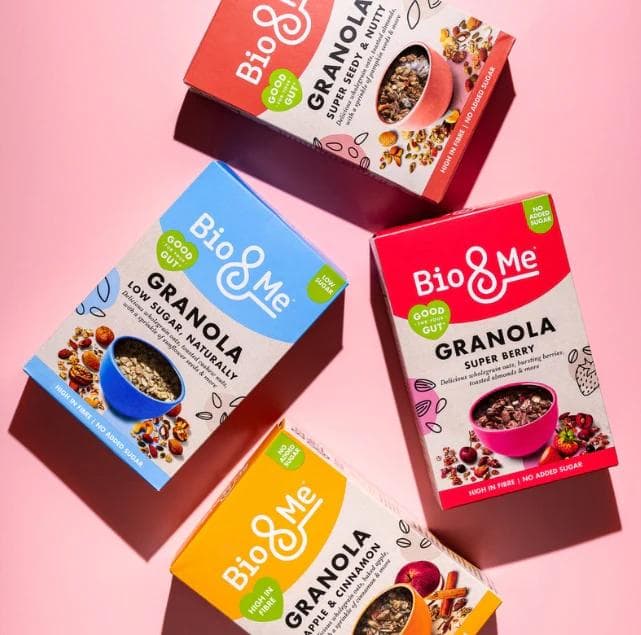
Bio&Me launched with prebiotic granola. Seven years on, the range spans granolas, mueslis, porridges, protein bars, porridge pots and live kefir yoghurts, all built around the same principle: high diversity of plant fibre, no added sugar, no emulsifiers.
| Year | Milestone |
|---|---|
| 2019 | Founded, launches granola range |
| 2021 | £3m retail sales |
| 2022 | Tesco listing secures 791 stores; fastest-growing cereal brand at +389% |
| 2023 | £10m expected retail sales; B Corp certified; 12 staff |
| 2024 | £7m quarterly run-rate, revenues doubled year-on-year; Harry Kane becomes investor |
| 2025 | 38,000+ distribution points; all Big Four supermarkets |
| 2026 | £20m+ run-rate; SME Brand of the Year and Entrepreneur of the Year at Grocer Gold Awards; ranked 60th in Sunday Times 100 |
That's not a brand chasing NPD for the sake of headlines. Each new format (bars, pots, smaller kefir drinks) has been introduced to solve a specific consumer friction rather than to pad the range. Walsh has been explicit about this in trade interviews, describing convenience for their consumer base as "don't make me give up my favourites" more than "grab and go":
"Fibre has been spoken about for a long time but it's always been seen as a bit worthy, bran and prunes. There's been no joy in it." -- Jon Walsh, Co-founder and CEO, Bio&Me, Just Food, May 2026
4. Why the SME Brand of the Year Category Was So Competitive
This wasn't a weak field. The 2026 shortlist for SME Brand of the Year included Dash Water, Heck Food, Little Dish, Moju and Pip & Nut, all established, well-distributed challenger brands with real trade recognition. Tesco led overall nominations with seven, Lidl had five, but Bio&Me was one of only a handful of brands with three nominations across the whole event, alongside Dash, Little Dish, Morrisons, Ocado and Trip.
| Finalist | Category strength |
|---|---|
| Bio&Me | Gut health, science-led NPD, fastest-growing cereal brand |
| Dash Water | Functional soft drinks, strong founder story |
| Heck Food | Meat-free and protein-forward NPD |
| Little Dish | Children's nutrition, strong retail penetration |
| Moju | Functional shots, wellness positioning |
| Pip & Nut | Nut butters, long-established challenger brand |
Winning against that group, and doing it with a double win (SME Brand of the Year plus Entrepreneur of the Year for both founders), tells you the judges weren't just rewarding growth numbers. They were rewarding a brand that had translated a genuinely differentiated position (evidence-based gut health, not just another "clean label" story) into commercial results at scale.
5. The Category Tailwind: Fibre Is Having Its Moment
Bio&Me isn't winning purely on execution. It's also riding a genuine structural shift in UK food and drink. Mintel data shows digestive and gut health claims were among the fastest-growing functional claims on new UK food and drink launches in the year to May 2026, alongside energy claims. Fibre specifically has moved from a niche, slightly worthy health message into what the trade press is now calling "fibremaxxing."
Growth in claim prevalence on UK NPD launches (indexed)
Energy claims       ███████████████████████  (2% to 3%, +50%)
Digestive claims     ███████████████████████  (1% to 2%, +100%)
Brain/nervous system ██████████████████████████████ (4% to 7%, +75%)
The government's recommended daily fibre intake is 30g. Average UK intake sits around 20g, a gap Walsh has publicly called out as the commercial opportunity underpinning the whole category: "the fibre gap." That gap is why Warburtons launched its own Fibre Fix bakery range in January 2026, and why brands from ready-to-drink coffee to sodas are now racing to add fibre claims, sometimes without the substance to back them up.
"There is a growing need for brands to go beyond 'high fibre' claims to stand out in the increasingly crowded gut health space." -- Emma Clifford, Associate Director, Mintel UK Food & Drink, The Grocer, June 2026
This is the part that matters most for the mid-market retailers reading this: a hot category attracts imitators fast, and imitators without genuine evidence get found out. Bio&Me's seven-year head start on the science is now its moat.
6. What the Conventional Growth Playbook Misses
Most challenger brands chasing supermarket listings default to one of two strategies: discount deep and hard to win distribution, or spend disproportionately on paid media to manufacture demand before the retailer will list you. Bio&Me did neither.
Instead, the brand built credibility first (through Rossi's existing clinical audience and content), then let retail buyers come to it on the strength of category data and consumer pull. Walsh has said plainly that the brand only put through one price increase in seven years, following the post-Ukraine input cost shock, while larger cereal companies pushed through four or five. That pricing discipline, protecting the value equation even as costs grow, has become a distribution advantage in its own right, particularly with value-conscious retailers like Asda and Morrisons.
"We do well in Asda and we do well in Morrisons and we're proud of that." -- Jon Walsh, Co-founder and CEO, Bio&Me, Just Food, May 2026
This is a pattern GrowSights sees constantly in the brands and retailers we work with: the businesses spending the most on analytics and marketing stacks aren't always the ones translating that spend into shelf presence or repeat purchase. We've written previously about the hidden cost of an over-built SaaS stack eating into retail margin. Bio&Me's growth came from a tighter loop: clinical credibility, retailer trust, and increasingly, rate of sale rather than pure distribution gains.
7. The Shift From Distribution Gains to Rate of Sale
This is arguably the most important operational detail in the whole Bio&Me story, and the one most SME brands never reach.
Walsh has been explicit that in the brand's early years, growth came almost entirely from winning new listings, more stores, more retailers, more shelf facings. That's the easy phase. The harder, more valuable phase is what Bio&Me has now entered: growth driven by increased rate of sale within existing distribution, and repeat purchase rates that have crossed 40% on key lines.
| Growth Driver | Early Phase (2019-2023) | Current Phase (2024-2026) |
|---|---|---|
| Primary growth source | New retailer listings | Rate of sale within existing stores |
| Repeat purchase rate | Building | 40%+ on key lines |
| Distribution footprint | Growing rapidly | 38,000+ points, largely established |
| Retailer relationship | Winning trust | Deepening category authority |
"The good news for us and them is, though, the majority of our growth now is coming from increased rates of sale." -- Jon Walsh, Co-founder and CEO, Bio&Me, Just Food, May 2026
This is the transition that separates SME brands that plateau after their first wave of listings from those that keep compounding. Distribution gains are finite and eventually get matched by competitors. Rate of sale growth, driven by genuine repeat purchase, is much harder for a rival to copy quickly. It's also exactly the kind of signal that gets lost in a standard weekly EPOS report if nobody is looking at it the right way, which is a theme we've explored in defining what we call retail growth engineering: the discipline of turning operational retail data into decisions that actually move sales, not just dashboards that describe the past.
8. Building Trust Beyond the Shelf: The Bowel Cancer UK Partnership
In May 2026, Bio&Me announced a partnership with Bowel Cancer UK, aiming to raise £100,000 in its first year through product campaigns, retail activity and educational initiatives. This wasn't a bolt-on CSR announcement. It's personally connected to Rossi's own history: her grandmother died from bowel cancer in 2009, an experience she has said shaped her entire career direction toward gut health research.
"As a brand rooted in science, we see a clear responsibility to translate evidence into everyday habits." -- Jon Walsh, Co-founder and CEO, Bio&Me, Bdaily, May 2026
The partnership leans on real clinical evidence too: research published in the British Medical Journal found that every additional 10g of daily fibre intake can reduce bowel cancer risk by roughly ten percent. Bowel cancer is the UK's fourth most common cancer, with someone diagnosed every 12 minutes.
For a brand built on scientific credibility, this kind of partnership isn't marketing decoration. It's the same product story extended into a public health cause, which is exactly the "really commercial, but also really values-driven" balance the Grocer Gold Awards judges called out.
9. Investment, Backing and the Harry Kane Factor
Bio&Me's growth hasn't been self-funded alone. The brand secured external investment as it scaled, including a notable backer in England men's football captain Harry Kane, who became an investor around 2022 as the brand's Tesco listing landed. In September 2024, Bio&Me also completed a funding raise off the back of revenues that had more than doubled year on year, with a retail sales run-rate at the time of £7m.
"Bio & Me is now in a really strong position to continue its growth rate across 2023, driven by consumer demand for products that taste good as well as do good." -- Jon Walsh, Co-founder and CEO, Bio&Me, The Grocer, September 2024
Celebrity investment can be a hollow signal in consumer brands when it's purely a logo on a press release. In Bio&Me's case, it has coincided with genuine, verifiable commercial acceleration rather than substituting for it, which is the distinction that matters for anyone assessing whether an investor name is a real growth signal or a vanity one.
10. What This Means for Mid-Market Retail Brands
Pull the Bio&Me story apart and a few patterns emerge that apply well beyond gut health food.
First: category tailwinds matter, but only if you got there with real substance before the tailwind arrived. Bio&Me had years of clinical credibility banked before "fibremaxxing" became a TikTok trend. Late entrants without that foundation are the ones Mintel is now warning will get "found out."
Second: distribution is a starting line, not a finish line. The brands that keep growing after the first wave of retailer listings are the ones actively managing rate of sale and repeat purchase, not just chasing the next store count milestone.
Third: founder-market fit is not a nice-to-have. Rossi's clinical authority and Walsh's FMCG retail fluency solved two entirely different problems that most single-founder SME brands struggle to solve at once.
Fourth: pricing discipline is a distribution strategy in disguise. One price rise in seven years, in an inflationary environment where competitors pushed through several, has protected Bio&Me's position with value-led retailers exactly when household budgets are under the most pressure.
Key Lessons for Retail Leaders
Lesson 1: Your category tailwind won't save a weak product story
Fibre and gut health are booming, but Mintel is already flagging brands making claims they can't substantiate. A tailwind accelerates a genuine story. It exposes a thin one.
Ask yourself: If the trend driving your category cooled tomorrow, would your product still have a reason to be trusted?
Lesson 2: Distribution wins are the easy phase, not the whole strategy
Getting listed is hard. Staying relevant on shelf, with rising repeat rates, is harder and far more valuable long-term.
Ask yourself: Do you actually know what proportion of your growth this year came from new distribution versus existing customers buying more often?
Lesson 3: Values and commercial discipline are not opposing forces
The judges praised Bio&Me for being both commercial and values-driven. Brands that treat purpose as a marketing layer rather than a structural part of the business tend not to sustain either.
Ask yourself: Would your brand's cause partnerships survive a year with no marketing budget behind them?
Actionable Recommendations
For Retail Business Owners and CEOs
- Audit whether your growth story is still distribution-led or has shifted to rate of sale. If you can't answer that with real data, that's the first gap to close.
- Resist the temptation to chase every adjacent NPD opportunity in a hot category. Bio&Me expanded format by format, solving specific consumer frictions, not just adding SKUs.
- Protect your pricing discipline even under cost pressure. It compounds into retailer trust over time.
For B2B Leaders and Suppliers to Retail
- If you sell into brands riding a category boom (fibre, protein, functional drinks), help clients differentiate on substantiated claims, not just trend positioning. The brands that get "found out" by regulators or consumer scepticism will need support fast.
- Build reporting that separates distribution growth from repeat-purchase growth. Most SME brands don't have this visibility until it's too late to act on it.
For Industry Strategists
- Watch which SME brands manage the transition from distribution-led to demand-led growth. That inflection point is the clearest early signal of which challenger brands will still be relevant in five years.
Final Summary
| Growth Category | What Bio&Me Did Differently | What Your Business Should Do |
|---|---|---|
| Product credibility | Built the science first, marketing second, using a founder's existing clinical authority | Audit whether your product claims would survive independent scrutiny before you scale marketing spend behind them |
| Distribution strategy | Won retailer trust through consumer pull, not discounting | Track buyer relationships as a trust asset, not a transactional negotiation |
| Growth phase management | Shifted deliberately from distribution gains to rate-of-sale growth | Build reporting that separates new-store growth from existing-customer growth |
| Pricing discipline | One price increase in seven years despite input cost inflation | Treat pricing restraint as a long-term distribution and loyalty strategy, not just a margin decision |
| Purpose and commercial performance | Combined a personal, evidence-backed cause partnership with continued sales growth | Build cause partnerships that are structurally connected to the product story, not bolted on for PR |
Grow Your Business With Integrated Data and Operational Intelligence
Bio&Me's win wasn't about a single tactic. It was about knowing, precisely, which lever to pull at which stage of growth: credibility first, distribution second, rate of sale third. Most mid-market retail businesses are sitting on the data to make that same call, but it's scattered across systems that don't talk to each other. That's the exact problem GrowSights was built to solve. Find out more about how we work and who we work with, or start a conversation about what your own growth data is already telling you.
Research sources: The Grocer (Grocer Gold Awards 2026 coverage, September 2024 funding announcement), Grocer Gold Awards official winners and finalists pages, Bdaily (Bowel Cancer UK partnership, leadership appointments), Just Food (Jon Walsh interview, May 2026), Food Manufacture (podcast interview and gut health trend coverage), The Gut Health Doctor / Bio&Me brand site, Startups 100 (2025 index), Chester and District Standard (Sunday Times 100 coverage), Food and Drink Technology (Tesco listing announcement), Mintel (UK food and drink NPD claims data).
Published by Growsights | Retail Intelligence and Growth Engineering | Point of View