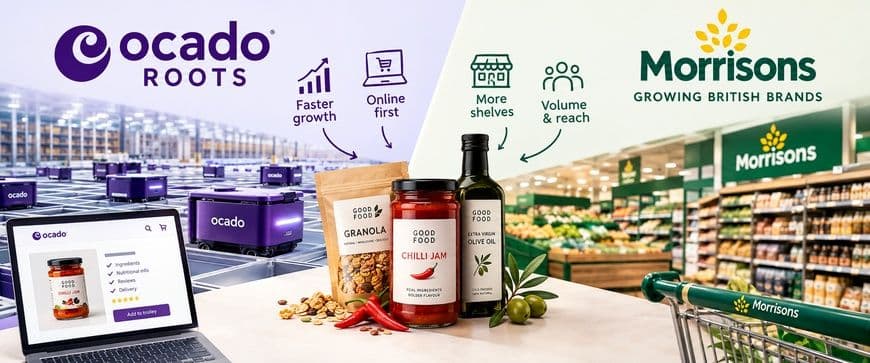
Ocado Roots vs Morrisons Growing British Brands: Two Doors Into Grocery, Two Different Games
One has no shelves and grew 13% in the latest 12-week period. The other has hundreds of shelves and four times the share. Your product probably suits only one of them.
Ocado is growing five times faster than the UK grocery market, and it still holds just 2.2% of it. Morrisons is growing at roughly the market rate and holds 8.4%. Same industry, same supplier forms. Completely different bets for a challenger brand.
Most guides to supermarket accelerators treat Ocado Roots and Morrisons Growing British Brands as two entrances to the same building. They aren't. One is a route into a robotic warehouse that sells to an affluent, online-first shopper. The other is a route into a store network that runs on price, volume and depots. If you pick on brand prestige instead of fit, you can win the listing and lose money on it.
This piece compares the two on the things a founder or a £5M to £50M supplier actually has to live with: scale, supply chain, product fit, cash, cost to serve, and how each retailer treats suppliers. Where the public record is thin, we say so. We would rather give you a short, accurate answer than a long, confident one.
If you read our Tesco Accelerator vs Sainsbury's Thrive guide, think of this as the same exercise for a very different pair.
1. The Scale Gap: A Fast Small Door and a Slow Big One
Start with the numbers, because they set expectations for everything that follows.
| Metric (12 weeks to 6 September 2026) | Ocado Retail | Morrisons |
|---|---|---|
| Sales growth, year on year | +13% | +2.8% |
| Share of UK grocery | 2.2% | 8.4% |
| Position | Fastest-growing grocer for the 30th period running | Sixth-largest by share, just behind Lidl (8.7%) |
| Households using it in the period | 4.4% | Not reported in the source |
Source: Worldpanel by Numerator data reported by Alliance News, 15 September 2026. Total UK grocery sales in the period: £36.21bn, up 2.6%.
Share of UK grocery, 12 weeks to 6 Sep 2026 (each block = 0.5 percentage points)
Aldi       █████████████████████  10.6%
Morrisons  █████████████████       8.4%
Ocado      ████                    2.2%
Put plainly, Morrisons is about 3.8 times Ocado's size by share (8.4 divided by 2.2, a GrowSights calculation). A national Morrisons listing could mean volumes that Ocado cannot match. But Ocado is where the growth is.
Ocado Retail's half-year to 31 May 2026 shows why buyers there are confident. Revenue rose 15.1% to £1,755.5m, orders climbed 12.8% to 554,000 a week, and the average basket value was £126.55, up 1.9%. Ocado Retail also moved to a small adjusted profit before tax of £11.6m, against a £17.1m loss a year earlier.
Morrisons, meanwhile, reported sales up 3.2% to £4.1bn in the 13 weeks to 26 July 2026, its fifteenth straight quarter of like-for-like growth, and has opened 71 new Morrisons Daily franchise stores so far this year.
One more number matters for the planning that follows. Worldpanel's August 2026 update noted that online remains the fastest-growing channel, but that online baskets are getting smaller. That is a warning for any supplier whose business case assumes ever-bigger Ocado orders.
Key insight for retail leaders: Don't ask which retailer is bigger. Ask which one your product can serve profitably at the volume you can realistically reach in year one.
2. What Each Programme Actually Is
Both programmes exist to find challenger brands. Beyond that, they differ in shape, openness and how much has been published.
| Ocado Roots | Morrisons Growing British Brands | |
|---|---|---|
| Launched | September 2024 | May 2021 |
| Who it targets | New suppliers launching on Ocado who are not yet listed with another major supermarket, plus brands launched in the last 12 months (as reported at launch) | Challenger brands with distinctive, innovative products that drive category growth and are ready to scale, invited to join |
| Initial scale | Up to 100 small suppliers | 497 stores at launch, plus Morrisons.com, food boxes and wholesale channels such as Amazon |
| Stated support | Bespoke onboarding and training, faster payment terms, a dedicated team, free data from Beet by Ocado, mentoring from established challenger brands | A team of experts advising on production, packaging, marketing and logistics; promotions and favourable payment terms were also reported at launch |
| How you get in | Apply to Ocado as a supplier; Ocado says Roots members join from there | Complete the "Supplying Morrisons" register of interest; Morrisons' sourcing team replies and invites the right brands in |
| What isn't public | Exact payment terms for members, intake size now | Eligibility thresholds, intake size, support terms |
Sources: The Grocer (Ocado Roots launch); Morrisons corporate supplier page; Grocery Gazette and Fruitnet (Growing British Brands launch).
A few things stand out.
Ocado Roots is a community, not just a listing. At launch, Ocado promised members a "purple carpet" of support, and chief commercial officer Amit Chitnis framed Roots as a community of up-and-coming brands. Ocado's own compliance report for 2025 to 2026 says it continued to develop Roots as a programme for smaller suppliers. Recent entrants include Mei Mei Goods, which launched exclusively on Ocado in April 2026 as its first UK retail listing and joined Roots, and She Grows Veg, which landed its first major retail deal with Ocado in February 2026.
Morrisons Growing British Brands is a fast-track, not an open application. Morrisons says it receives register-of-interest forms and invites suitable brands into the programme. It attracted more than 1,000 applications in its first six months. Winny's Kitchen, the Birmingham jerk sauce brand, was an early success story with national distribution.
Morrisons also runs a second route that many founders overlook. The Local Foodmakers programme offers direct supply to stores, simplified agreements and preferential payment terms for locally loved producers. For a regional brand, that can be a better first step than a national programme.
"long, risky and complicated process" -- David Potts, then Morrisons CEO, describing getting a product to market at scale, Growing British Brands launch, 2021
Key insight for retail leaders: Roots publishes its promises (faster payment, free data, mentoring). Morrisons publishes its intent. When a programme doesn't publish its terms, treat the terms as a negotiation and ask for them in writing before you commit stock.
3. Supply Chain: A Store Network Against a Robotic Warehouse
This is where the two doors really diverge, and where the most expensive surprises hide.
Ocado doesn't have stores. It has Customer Fulfilment Centres (CFCs): large automated warehouses where robots pick orders that are then trunked to smaller sites and delivered in Ocado vans. That model shapes everything a supplier has to do.
Here is what Ocado's own Grocery Supplier Manual (version 3.0, September 2023, published on Ocado Retail's sustainability site) tells suppliers.
| Requirement | What the manual says |
|---|---|
| Where you deliver | Suppliers need to deliver to all Ocado CFCs (the manual lists seven); Lineage handles frozen stock and CEVA acts as a consolidator |
| Delivery windows | Within 30 minutes either side of the slot; late or early deliveries risk rejection |
| Why timing matters | 80% of customer orders have already been sold before stock arrives |
| Pack size | Each saleable item must fit an Ocado delivery tote (534mm x 340mm x 334mm) |
| Vehicles | Rigid or articulated lorries only; no vans into CFCs. Small ambient orders (under 10 cases and 25kg) can use a parcel service via a consolidator |
| Pallets | Wooden, British Standard 2629, CHEP, LPR or IPP; no Euro, white or cardboard pallets |
| Shelf life | A minimum acceptable life is agreed before launch; anything shorter is rejected |
| Systems | EDI, advance shipping notices and pallet SSCC labels expected; suppliers get access to the Olive supplier portal |
| Content | A product won't launch until at least one image and full back-of-pack data are approved, normally supplied via Brandbank |
| Safety accreditation | BRCGS or a GFSI equivalent, BRC Start, or SALSA, depending on product |
In 2023 Ocado said new suppliers could start with a single case delivery to each depot. That is genuinely helpful for a tiny brand. A 2021 Bord Bia guide for Irish suppliers adds the reality check: initial orders come in cases or layers rather than pallets, small suppliers are advised to use consolidators such as PW Gates (ambient) or Lineage (frozen), and the cost of frequent small deliveries has to be built into the commercials from day one.
Morrisons is the opposite problem. It's a conventional supply chain of depots and stores, plus its own manufacturing. We could not find a public Morrisons equivalent of Ocado's supplier manual in our research. That doesn't mean it doesn't exist; it means you should ask the sourcing team for logistics requirements in writing before you agree to a launch date. Local Foodmakers suppliers can deliver direct to stores. National Growing British Brands suppliers, by contrast, are expected to be ready for national distribution.
Key insight for retail leaders: At Ocado, your logistics must be precise. At Morrisons, your logistics must be scalable. Both are hard, but they punish different weaknesses.
4. Product Fit: What Sells Online Against What Sells in Store
The shelf is physical at Morrisons and digital at Ocado, and shoppers behave differently in each.
Ocado's own pitch is that it isn't constrained by shelf space. In 2023 Ocado Retail's chief executive Hannah Gibson said the operating model means "we're not bound by shelf space", so there's room for new producers. The Bord Bia guide, written in 2021, reported Ocado carrying around 58,000 items and noted that a product can sit in several virtual aisles at once, which a physical shelf cannot do.
That sounds like a gift to small brands, but the same guide explains the catch. Online discovery is harder. Shoppers lean on search, favourites and repeat baskets. The guide, citing Ocado data from the time, reported that roughly 80% of the products shoppers buy are repeat purchases, and almost 60% shop from their favourites list. It also noted that about 80% of clicks happen on the first page of search results. Those are 2021 figures, so treat them as a direction of travel rather than a current benchmark.
| Fit factor | Ocado Retail | Morrisons |
|---|---|---|
| Shopper | Skews affluent, with London and the South East most likely to shop online, per Worldpanel | Broader and more price-led; the group credits low prices for recent growth |
| What wins | Strong imagery, clear copy, correct category tagging, reviews, search ranking | Shelf impact, price point, promotional support, rate of sale per store |
| Basket | £126.55 average (H1 2026), so premium and trade-up lines can work | Had the smallest average online basket of the big grocers in 2019 (Bord Bia guide); price matters more |
| Discovery | Algorithmic and personalised; paid media and coupons help new brands | Physical shelf placement, promotions, in-store visibility |
| Best early fit (GrowSights view) | Premium, health-led, innovative, convenient, giftable, well-photographed products | Familiar-format, value-conscious, high-rotation lines that can hold a price point |
The table's final row is our judgement, not a retailer statement. It is a starting hypothesis for you to test with buyers.
Key insight for retail leaders: Online grocery doesn't remove the shelf problem. It replaces a physical shelf with a search results page.
5. Cash: The 14-Day Promise and the £100,000 Cliff
For a growing supplier, payment terms often matter more than margin. The two retailers' official payment practice filings tell a useful story.
| Metric | Ocado Retail | Morrisons |
|---|---|---|
| Reporting period | 30 Sep 2025 to 29 Mar 2026 | 27 Oct 2025 to 26 Apr 2026 |
| Standard terms | 30, 45 and 60 days; variations agreed case by case | 14 days for small suppliers (under £100,000 of annual sales to Morrisons, invoicing electronically); 7 days for livestock |
| Average time to pay | 28 days | 50 days (all suppliers) |
| Signed a payment code? | No | No |
Source: UK Government Check Payment Practices service. Both figures are self-reported by the retailers.
Days to pay (latest filings)
Morrisons, small-supplier standard terms  ██████████████                                        14
Ocado Retail, average actual              ████████████████████████████                          28
Morrisons, average actual, all suppliers  ██████████████████████████████████████████████████    50
The chart needs careful reading. Morrisons' headline 14-day terms are very attractive, but they apply only to suppliers with less than £100,000 of annual sales to Morrisons who invoice electronically. Earlier Morrisons filings say everyone else is on standard terms of 30 or 60 days, and the group's average across all suppliers was 50 days. That means a growing supplier can hit a cash flow cliff: succeed, cross £100,000, and your payment terms can lengthen at exactly the moment your working capital needs jump.
Ocado's average of 28 days is shorter, and Roots members are promised faster terms. But the public record doesn't say how much faster, so ask.
Key insight for retail leaders: Before you celebrate a listing, model the cash you'll be out of pocket at 30, 60 and 90 days of sales. Growth that you can't finance is just a faster way to fail.
6. Cost to Serve: What Ocado Publishes and Morrisons Doesn't
Cost is where Ocado's openness is most useful, because its supplier manual includes a charging policy.
| Charge (Ocado Supplier Manual v3.0, 2023) | Amount |
|---|---|
| Failed delivery or rejected load | £20 admin plus £5 per pallet |
| Early or late delivery (more than 60 minutes) | £20 admin plus £5 per pallet |
| Incorrect pallet presentation | £20 per pallet |
| Incorrect paperwork | £20 admin per delivery |
| Storage and collection of non-conforming stock | £5 per pallet, plus cost price if already received |
| Product withdrawal | £79.03 admin plus £37.51 per affected site, plus cost of stock |
| Product recall | £141.32 admin plus £37.51 per affected site, plus retail price of stock |
| Customer quality refund | £4.93 (contact centre) or £0.28 (app) plus retail price, plus £4.08 monthly admin |
| In-house product photography (exceptional cases) | £100 per SKU for images and £50 per SKU for back-of-pack |
Three points matter beyond the numbers.
First, the manual is dated September 2023. Figures may have changed. Treat this table as a guide to the types of cost, then ask Ocado for the current rate card.
Second, promotional funding works on triggers. Ocado calculates unit-trigger funding and invoices it. Customers can add promotional items during the promotion for delivery up to 28 days later, and triggers are based on the order date, so your funding exposure can run beyond the promotion window. Ocado also uses a third-party forensic auditor, PRGX, to review historic invoicing, and has agreed to limit claims to the current and previous two financial years, if suppliers reciprocate.
Third, data is a real cost line. The 2021 Bord Bia guide described Ocado's category insight product, Crunch Grocery Insights, as a paid service. Roots members now get free data from Beet by Ocado, which is a meaningful benefit for a brand with no UK rate-of-sale history.
For Morrisons, we couldn't find a comparable public charging schedule, so the honest advice is the same as before: request the supplier terms, including promotional funding and any logistics or waste charges, in writing. We cover the wider topic in our planned guide to what it really costs to get listed.
Key insight for retail leaders: A published charging policy isn't a negative. It is information. The risky retailer is the one whose charges you only discover after you've shipped.
7. How Fairly Do They Treat Suppliers? The GCA's 2026 Scorecard
Both Ocado and Morrisons are designated under the Groceries Supply Code of Practice, which covers retailers with UK groceries turnover above £1bn and is policed by the Groceries Code Adjudicator (GCA). Each has a named Code Compliance Officer independent of its buyers.
The GCA's 2026 annual survey, published in April, ranks the 14 designated retailers by the share of suppliers who say they consistently or mostly follow the Code.
| 2026 rank | Retailer | 2026 score | 2025 score |
|---|---|---|---|
| 1 | Waitrose | 98% | 98% |
| 6 | Ocado | 94% | 97% |
| 13 | Morrisons | 89% | 92% |
| 14 | Amazon | 69% | 66% |
Share of suppliers saying the retailer follows the Code (2026)
Waitrose   ██████████████████████████████████████████████████  98%
Ocado      ███████████████████████████████████████████████     94%
Morrisons  ████████████████████████████████████████████▌       89%
Both retailers slipped year on year, and Morrisons now sits second from the bottom. The average across all 14 retailers was 92%. The survey also found 32% of suppliers reported at least one Code issue, up from 30%. The most common problems were slow resolution of invoice discrepancies (20%), costs from inaccurate forecasting (18%), delisting without reasonable notice (15%) and late payment (14%).
"a critical reminder that the retailers must focus on ensuring Code compliance" -- Mark White, Groceries Code Adjudicator, GCA 2026 survey results, April 2026
A caution on interpretation. These scores come from all direct suppliers, not just accelerator members, so they say nothing specific about Roots or Growing British Brands. They are still a useful signal about the retailer behind the programme, especially the two issues most relevant to challenger brands: forecasting and delisting.
Key insight for retail leaders: Ask each retailer directly how forecasts are shared and how much notice you get before a delisting. The GCA's own data says those are the weak spots.
8. The Tangle: Morrisons.com Runs on Ocado Technology, But They Are Not the Same Company
This confuses a lot of founders, so it is worth a short section.
Ocado Group, the technology business, provides its platform to two UK grocery partners: Ocado Retail and Morrisons. Ocado Retail is the online supermarket at ocado.com, a 50:50 joint venture with Marks & Spencer. Morrisons.com is Morrisons' own online grocery service, which uses Ocado technology and has done since 2013.
| Date | What happened |
|---|---|
| 2013 | Morrisons and Ocado begin working together; Morrisons shares capacity at the Dordon CFC |
| 2019 | Morrisons says it will no longer be Ocado's exclusive digital partner and hands back some Erith capacity |
| November 2024 | Morrisons says it will "gradually cease" deliveries from Ocado's Erith CFC, build volumes from Dordon, and fulfil more online orders from its stores using Ocado's in-store technology |
| November 2024 (continued) | Morrisons.com continues to serve every postcode in England, Wales and Scotland, and Erith capacity opens up for Ocado Retail |
| 2026 | Ocado Group's half-year results still describe Morrisons and Ocado Retail as its two UK partners |
The practical takeaway: a listing with Ocado Retail doesn't put you on Morrisons.com, and vice versa. They are different buyers, different range decisions and different customers. Also note that Ocado Retail's range includes M&S products since 2020, so you are competing with an own-label range that has real scale behind it.
Key insight for retail leaders: Two retailers sharing a technology provider are still two sales channels. Treat them as separate negotiations.
9. Sequencing: Eligibility Rules Can Decide Your Order
Here's something we think most founders miss. Roots, as reported when it launched, is open to new suppliers launching on Ocado who aren't yet listed with another major supermarket, plus brands that launched in the last 12 months. Ocado's earlier "Britain's Next Top Supplier" competition also required that the product not be stocked at Asda, Waitrose, Morrisons, Tesco or Sainsbury's.
If that restriction still applies, it creates a sequencing problem. Take Morrisons first and you could be ineligible for Roots. Take Ocado first and you keep both options open.
This matches how Ocado describes its own role. Bord Bia's guide called Ocado a test-and-learn environment and a stepping stone to Tesco or Sainsbury's. Ocado also describes its IND!E initiative as a nursery for brands that later come up through Roots. The logic is a ladder: prove rate of sale on a smaller, data-rich platform, then take the evidence to the bigger buyers.
| If you... | Then consider... |
|---|---|
| Have no UK rate-of-sale history | Ocado first, using Roots data (Beet) to build a track record |
| Are regional, with a locally loved product | Morrisons Local Foodmakers, with direct-to-store supply |
| Have a proven national product with retail-ready volume | Morrisons Growing British Brands, with scale in mind |
| Are already listed at another major supermarket | Check Roots eligibility before applying; you may no longer qualify |
Check current criteria with both retailers. Eligibility rules change, and the report we have is from launch.
Key insight for retail leaders: The order of your listings is a strategic decision. Don't let a first yes foreclose your best second option.
10. Timing: Why This Is Range Review Season, and Why Your 2027 Christmas Starts Now
It's mid-October. Christmas 2026 listings are long since decided. The useful question for a supplier now is how to be ready for the next round.
Neither retailer publishes a range review calendar in the material we found, so we can't give you dates. What we can tell you comes from Bord Bia's 2021 guide to Ocado, which is dated but still instructive on process:
| Stage | Reported timing (2021 guide) |
|---|---|
| Online application reviewed by a buyer | Up to eight weeks |
| Buyer meetings | Fit into range review windows that open only at certain times of the year |
| Acceptance to on-shelf | Realistically at least three months |
| Start to finish, in some cases | Up to 12 months |
Even if Ocado has sped things up since, the point holds: a pitch made in the next few weeks realistically lands on shelf in 2027, and a product aiming for Christmas 2027 needs its application, samples and logistics in order in the first half of the year. The festive period is worth planning for: The Grocer's Gold Awards coverage says Ocado Retail posted its highest-ever festive sales at Christmas 2024.
Key insight for retail leaders: Range review season is a supplier's planning season. The founders who get Christmas listings are the ones who prepared in February.
11. The GrowSights Diagnosis: You're Choosing a Business Model, Not a Programme
Here's the sharper framing. Founders ask, "Which programme is better?" The better question is, "Which retailer's economics can my product survive in year one?"
Ocado is a small, fast-growing, data-rich, high-service-intensity channel. It rewards polished content, tight logistics and a product that fits an affluent online basket. It punishes missed delivery windows and thin imagery.
Morrisons is a large, slower-growing, price-led, volume channel. It rewards a product with proven rate of sale, a price point that holds and the ability to scale production. It punishes brands that can't fund promotions or absorb longer payment terms once they outgrow the small-supplier threshold.
At GrowSights we describe this as a listing P&L. It's a weekly view of what a listing really earns once you add every cost it creates. Here's the template:
| Line | Ocado route | Morrisons route |
|---|---|---|
| Revenue per week | Orders from CFCs, often small and frequent | Store or depot orders, larger and slower to build |
| Retailer margin and promo funding | Negotiated; trigger-based funding | Negotiated; ask for terms in writing |
| Logistics | Consolidator or multiple CFC deliveries; tight windows | Depot or direct-to-store, depending on programme |
| Charges and recharges | Published charging policy | Request the schedule |
| Content and media | Imagery, Brandbank, paid media, coupons | In-store support, promotions |
| Waste and returns | Customer refund recharges | Store and depot waste terms |
| Working capital | 30 to 60 day terms, 28-day average actual | 14 days under £100k, longer after |
We haven't put numbers in the table because they depend on your category, your price and your negotiation. But if you can't fill in every line before you commit stock, you aren't ready to commit stock.
A short decision test:
| Question | Points to Ocado | Points to Morrisons |
|---|---|---|
| Does your product fit a 534 x 340 x 334mm tote and survive picking? | Yes | Less relevant |
| Do you have UK rate-of-sale data? | No: use Beet to build it | Yes: use it to win scale |
| Can you fund 30 to 60 day payment terms? | More comfortable | Under £100k is easier |
| Is your core shopper affluent, urban and online-first? | Yes | Less so |
| Are you already listed at another major supermarket? | Check Roots eligibility | Natural next step |
| Do you have budget for imagery, copy, coupons and media? | Needed | Needed, but different |
Count the ticks. If most point one way, start there. If they split, "Ocado first, Morrisons second" is a common sequence, but test it against your own numbers before you commit.
Key Lessons for Retail Leaders
Lesson 1: Fit beats prestige
Both retailers are credible names for a challenger brand. Neither is automatically right. A beautiful pack that can't survive a tote, or a premium product with no price headroom, will struggle in the wrong channel.
Ask yourself: Which retailer's shopper, logistics and price expectations does my product already match?
Lesson 2: Cash terms are a growth constraint
Morrisons' 14-day terms for small suppliers are generous, but the £100,000 threshold means they don't last as you grow. Ocado's 28-day average is workable but needs financing. Build a cash model before you scale.
Ask yourself: What happens to my working capital in the quarter after I cross £100,000 with Morrisons?
Lesson 3: Published rules are an advantage
Ocado's supplier manual lets you cost compliance before you start. Where a retailer publishes less, ask more.
Ask yourself: Do I have the retailer's charging schedule, promotional funding terms and delisting notice period in writing?
Lesson 4: Sequence your listings deliberately
Roots' eligibility, as reported, favours brands not yet listed at another major supermarket. Your first listing can close the door on your preferred second one.
Ask yourself: If I take this listing first, which programmes does it rule me out of?
Lesson 5: A listing is the start of the work
The GCA found delisting without reasonable notice and forecasting costs among the top supplier complaints in 2026. Rate of sale keeps you listed.
Ask yourself: What rate of sale do I need to hit in the first 12 weeks to survive my first range review?
Actionable Recommendations
For Retail Business Owners and CEOs
- Decide your first channel using the decision test in Section 11, then document why.
- Build a weekly listing P&L before you accept a listing, with every cost line filled in.
- Ask both retailers for current supplier terms in writing: payment, promotions, charges, delisting notice.
- Model cash at 30, 60 and 90 days, and model the £100,000 threshold at Morrisons.
- Start your Christmas 2027 and Halloween 2027 pitch preparation in the first half of next year.
For B2B Leaders and Suppliers to Retail
- If you pursue Ocado, build to its manual: tote-friendly packs, agreed minimum life, EDI, barcodes, Brandbank content and a consolidator plan.
- If you pursue Morrisons, prepare production and logistics for national scale, and ask which programme route fits: Growing British Brands or Local Foodmakers.
- Check the GCA's 2026 survey results for each retailer you plan to supply, and note the forecasting and delisting issues.
- Track rate of sale weekly from day one. You need it for your next negotiation.
For Industry Strategists
- Watch Ocado Retail's growth against basket size trends, because smaller online baskets change the economics for small suppliers.
- Watch whether Roots publishes outcomes, such as how many members win listings elsewhere.
- Watch the GCA's ongoing work on forecasting and delisting, which affects every challenger brand.
Final Summary
| Failure Category | What Went Wrong | What Your Business Should Do |
|---|---|---|
| Channel choice | Picked the programme by name, not by product and economics | Use the fit test; choose the retailer your product already suits |
| Supply chain readiness | Pack, shelf life or delivery didn't meet the retailer's rules | Read the supplier manual; cost the logistics; use a consolidator if needed |
| Cash flow | Terms lengthened or stayed long as volume grew | Model working capital; plan for the £100,000 Morrisons threshold |
| Hidden costs | Charges, promo funding and recharges discovered after shipping | Get charging and funding terms in writing first |
| Sequencing | A first listing ruled out a better second route | Check eligibility rules before accepting any listing |
| Retention | Low rate of sale led to delisting | Track weekly sales; build a plan for the first range review |
Grow Your Business With Integrated Data and Operational Intelligence
Choosing between Ocado and Morrisons is a data question before it is a pitch question. At GrowSights we help mid-market brands see what a listing really earns, using the integrated approach described on our How We Work page. If you're a £5M to £50M supplier weighing a grocery listing, see who we work with and explore more of our thinking in the Point of View hub. To talk through your own listing P&L, start a conversation here: https://growsights.co.uk/start-a-conversation
Research sources: Worldpanel by Numerator data via Alliance News/MarketScreener (15 Sep 2026) and Food Management Today (Feb 2026); Worldpanel summary (Aug 2026); Ocado Group half-year results for the 26 weeks to 31 May 2026 (RNS, 16 July 2026); Morrisons Q3 trading, via Grocery Gazette (Sept 2026); The Grocer (Ocado Roots launch, Sept 2024; Gold Awards coverage); Ocado Retail Grocery Supplier Manual v3.0 (Sept 2023); Ocado Retail GSCOP Annual Compliance Report 2025 to 2026; UK Government Check Payment Practices (Ocado Retail, Morrisons); Morrisons corporate supplier page; Morrisons Growing British Brands launch coverage (Grocery Gazette, Fruitnet, The Retail Bulletin, 2021); Grocery Gazette (Mei Mei Goods, 2026; Ocado and small suppliers, 2023); Retail Times (She Grows Veg, 2026; Ocado suppliers, 2023); Groceries Code Adjudicator 2026 survey via KamCity (April 2026) and GCA newsletter (May 2026); Ocado Group/Morrisons announcements via Retail Gazette, Retail Week and Reuters (Nov 2024); Bord Bia, "The Ocado Opportunity" (Aug 2021). Pricing, terms and eligibility can change, so confirm current details with each retailer.
Published by Growsights | Retail Intelligence and Growth Engineering | Point of View