Asda, Aldi and M&S Supplier Programmes: How to Get Listed Without an Accelerator
Tesco and Sainsbury's reward a brand for being a brand. Asda, Aldi and M&S reward a supplier for being the right supplier. Pitch the wrong way and you lose months.
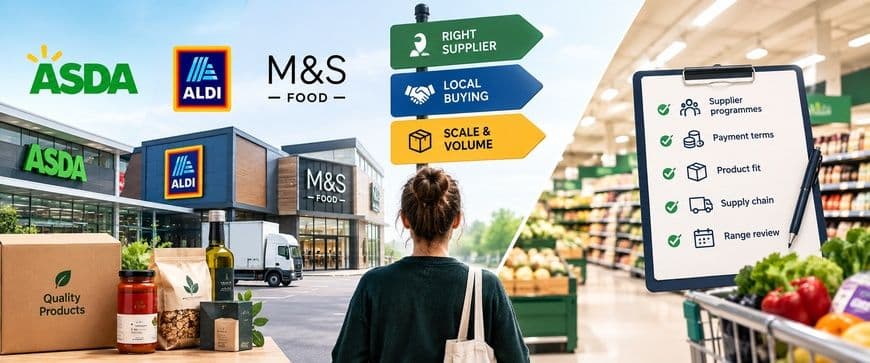
If you have read our guides to Tesco and Sainsbury's and to Ocado Roots and Morrisons, you know the pattern: a named programme, a cohort, a mentor, a route to shelf. Asda, Aldi and M&S don't quite work that way. They each have real routes in, but the routes look different, and the difference matters more than the programme names.
This is the last guide in our series on UK supermarket supplier programmes. It explains how to become a supplier to Aldi, how to get listed at Asda, what M&S Food of the Future is, and how their payment terms compare. It also covers two pieces of news from this month that change the backdrop for any supplier planning 2027 range reviews.
One caution before we start. These retailers publish less than Ocado does. Where we couldn't find a source, we say so, and we label our own judgement as ours.
1. What Is Changing in UK Grocery This Month?
Two stories broke in October 2026, and both matter if you sell to supermarkets.
What is the CMA's Aldi and Lidl land ruling? On 22 October 2026 the Competition and Markets Authority confirmed that Aldi, Lidl GB and Lidl NI will be designated "Large Grocery Retailers" under the Groceries Market Investigation (Controlled Land) Order 2010. That Order has applied to Asda, Co-op, M&S, Morrisons, Sainsbury's, Tesco and Waitrose since 2010. It stops designated retailers using restrictive covenants and exclusivity arrangements in land deals to make it harder for rivals to open nearby. Existing agreements can now be reviewed on request from landowners, developers and rival supermarkets.
Morrisons, Waitrose and Iceland backed the proposal, and Aldi and Lidl made no representations to the CMA. City AM reports that both discounters say their expansion plans continue. Aldi has confirmed £900m of investment and around 40 new stores in 2027 as it works towards 1,500 UK stores.
Why are Sainsbury's and Morrisons in the news? On 5 October, reports based on the Financial Times and Sky News said Sainsbury's held preliminary merger talks with Morrisons between November 2025 and February 2026, then walked away. There are no active talks, but a future deal hasn't been ruled out, and Asda has been cited as a possible participant in any fresh round of consolidation. Morrisons is owned by Clayton, Dubilier & Rice, and its debts were reported at £7.52bn.
What does it mean for suppliers? Nothing here changes a listing decision overnight, and the effects are indirect. This is our view, not a retailer statement:
- Two discounters with their own-label-heavy, price-engineered model are still opening stores, so more grocery volume may flow through that model over time.
- Talk of consolidation is a reminder that buyer power can concentrate. Fewer, bigger buyers usually means tougher negotiations.
- Both make it more important to know your terms, your channel mix and your options before the next range review.
Key insight for retail leaders: The market is moving towards fewer, larger and more price-focused buyers. A supplier with one big customer and no plan B is more exposed this winter than last.
2. What Are the Main Supermarket Supplier Programmes in the UK?
The programmes we have covered so far fall into three families. The programme names change, but the logic doesn't.
| Family | Examples in our series | How they work |
|---|---|---|
| Brand accelerators and incubators | Tesco Accelerator, Sainsbury's Thrive, Co-op The Apiary, Waitrose BrandsNew, Ocado Roots, Morrisons Growing British Brands | A cohort, mentoring and a route to listing. Best for brands with a story and some traction |
| Wholesale and discounter routes | Lidl Kickstart, Iceland Brands on Ice, Bidfood Open Doors | Entry through a discounter programme or a wholesale partner, instead of a cohort-and-mentor model |
| Supplier routes, not brand programmes | Aldi, Asda, M&S | Local buying, trials, TV-style competitions and own-label supply. Best for suppliers who can meet a price and a volume |
For the first family, see our guides on Tesco versus Sainsbury's, Ocado Roots versus Morrisons and the Tesco Accelerator 2026 cohort. This guide covers the third family.
3. How Is a Brand Pitch Different From a Supplier Pitch?
A brand pitch says: "Here is my product, my story and my early sales. Help me grow." A supplier pitch says: "Here is a product that meets your price, specification and volume. I can deliver it reliably."
Accelerators like Tesco's are built for the first pitch. Aldi, Asda's local buying teams and M&S's own-label model respond mostly to the second. Founders who turn up with a brand story at a buyer who wants a cost price and a capacity plan can struggle to get a second meeting.
| Brand pitch | Supplier pitch | |
|---|---|---|
| Lead with | Story, shopper insight, social following | Price, specification, capacity, reliability |
| Buyer cares about | Newness, brand-building potential | Margin, availability, consistency |
| Typical home | Accelerators and incubators | Aldi, Asda Local, M&S own-label |
| Risk | Underfunded growth | Price pressure and volume commitments |
Key insight for retail leaders: Decide which pitch you are making before you choose a retailer. The same product can win in one model and fail in the other.
4. How to Become an Aldi Supplier
Aldi doesn't run an accelerator. Its routes in are open calls, competitions and long-term supply agreements, and all of them are built around price and scale.
What does Aldi say it wants?
Aldi says about 75% of its sales come from British suppliers, and it reportedly spent around £14bn with British suppliers in 2025. It also wants at least half its products covered by long-term supplier agreements by 2027. In May 2026 it announced more than £5bn of long-term deals, although FarmingUK noted it didn't say how much was new spending.
The four routes in
| Route | What it is | Status and notes |
|---|---|---|
| Supplier registration | Aldi's becoming-a-supplier page covers food, drink and Specialbuys | Open call-outs repeated in 2022 and 2023 trade coverage; check the page for current criteria |
| Aldi's Next Big Thing | Channel 4 series where suppliers pitch to Aldi's buying director; winners get a Specialbuy listing in 1,000+ stores. Series two aired from April 2024 | We found no later UK series, so treat it as unconfirmed |
| Grow With Aldi | UK competition in 2022 for a temporary Specialbuy listing; the Irish programme is in its eighth year | Irish winners for 2025 reached 166 stores from January 2026; 2026 applications closed on 30 January |
| Long-term agreements | Multi-year supply deals, mainly in fresh produce and core categories | Targeted at suppliers who can show quality, availability and value |
For Irish and Northern Irish suppliers, Grow With Aldi is the clearest published route, and it pairs naturally with the Lidl Kickstart route we have covered before.
What does Aldi look at when choosing a supplier?
On Next Big Thing, the factors reported by Grocery Gazette were consumer demand, price, packaging and the ability to scale up. That is a good checklist for any Aldi approach.
What do founders say about the experience?
The picture is mixed. One Grocer comment piece reported a contestant describing a "mismatch" between small producers and Aldi's volume and price expectations, while winners praised the support they received after winning. A GS1 UK panel of founders described Aldi as volume-led and said suppliers should expect their product to be cost-engineered.
A practical checklist: how to approach Aldi
These steps are our suggestions, not an Aldi process:
- Know your cost price at three volumes. Aldi's model works on price, so know what you can do at 10 times your current output.
- Check your capacity. Can you scale production without breaking quality or service?
- Simplify the product. Expect conversations about packaging, pack size and specification.
- Consider Specialbuys first. Temporary listings are a lower-risk way to test.
- Read the payment terms before you sign. Aldi's latest filing shows an average of 37 days (see Section 7).
Key insight for retail leaders: Aldi isn't a brand-building route. It is a route to volume, and the price you pay is margin and negotiating power.
5. What Is Asda Nurture, and How to Get Listed at Asda?
Asda has two things worth knowing: a past incubator called Nurture, and a stronger and more current local buying model.
What is Asda Nurture?
Asda launched Nurture in October 2021 as an incubator for emerging and entrepreneurial brands. It promised easier access to shelf space, data to improve ranges, supply chain training and a dedicated team. Asda's buying teams also partnered with the product discovery platform RangeMe. In March 2022 the first 15 brands were listed, giving 46 lines in about 100 stores, with mentoring from Asda's experts.
We found no later cohort announcements, so we can't confirm that Nurture is still running as a named programme. If you plan to apply, ask Asda directly and check how its buying teams currently source emerging brands.
What is the Asda Local route?
Asda has long run regional local buyers for Wales, Scotland, Northern Ireland and England. In 2023 Asda's local buying manager for Scotland described three routes for local suppliers: start with local products in only a few stores, go national with UK-wide listings, or make own-label products for Asda.
That "start small" idea is the heart of how to get listed at Asda. A regional listing in a handful of stores lets a small supplier prove rate of sale before taking on national logistics.
The Welsh Supplier Development Programme
In July 2026 Asda announced a Supplier Development Programme with Food and Drink Wales, backed by the Welsh Government. More than 30 Welsh suppliers take part in three days between August and October:
- Day one: a Cardiff store visit to meet senior directors and general store managers and get one-to-one feedback.
- Day two: Asda's Chepstow depot, covering supply chain and logistics, including how to book a depot delivery slot.
- Day three: Asda's Leeds head office, covering finance, trading and Asda's systems.
It is a good template for how Asda approaches smaller suppliers: practical, regional and operational.
What does Asda ask of local suppliers?
The most useful published criteria we found are from a 2019 Scottish meet the buyer event: products had to be retail ready, suppliers needed SALSA accreditation or equivalent, and they needed the ability to deliver direct to store. These are dated and specific to Scotland, so treat them as an example of the type of requirement, not as current rules.
How to get listed at Asda: a short route map
| Step | Action |
|---|---|
| 1 | Identify the Asda local buyer for your region and ask how they currently source new suppliers |
| 2 | Check whether RangeMe or a regional meet-the-buyer event is the entry point |
| 3 | Prepare retail-ready product, food safety accreditation and a delivery plan |
| 4 | Propose a small regional listing first, with a clear rate-of-sale target |
| 5 | Agree payment terms in writing before shipping stock |
Key insight for retail leaders: Asda's strength for a small supplier is local, staged growth. Its risk is what happens to your cash flow once you stop being "small" (see Section 7).
6. What Is M&S Food of the Future?
M&S is a predominantly own-label retailer, so its route is different again. You aren't trying to get your brand on shelf. You are trying to become an own-label supplier, or to earn a trial.
M&S Food of the Future is a programme for innovative suppliers. M&S says its main objective is to develop exciting and unique own-label products outside its existing supply chain, while giving new suppliers a chance to be discovered by customers.
How does M&S Food of the Future work?
According to M&S's own page:
- A brand is identified by a dedicated M&S Food team.
- The team reaches out to discuss a 12-week fixed trial.
- Products launch in up to 50 M&S stores.
- The supplier gets weekly sales updates and a six-weekly check-in at the M&S Support Centre or on Teams.
- If the trial succeeds and the product meets M&S's technical standards, M&S will explore collaborative own-label development.
What does M&S offer, and what is the catch?
The offer includes a 12-week in-store listing in up to 50 top-performing stores, on-shelf marketing created with M&S's marketing teams, weekly sales data and customer insights at the end of the trial. Two founders quoted on the page say the trial let them prove rate of sale, and one says it led to permanent listings in selected stores.
The catch is stated plainly on the same page. The 12-week trial doesn't guarantee a listing, products may be delisted for commercial reasons at the end, and suppliers shouldn't invest or make business decisions linked to the trial without written agreement from M&S.
Why does M&S being own-label matter?
When M&S changed its wholesale partner for third-party branded goods, it said the move didn't signal more third-party brands on its shelves, and that its focus remained on own-brand ranges. For a founder with a strong brand, that means M&S is rarely a place to build your name. It is a place to supply a product made to M&S's specification, under M&S's label, and potentially at scale.
M&S also owns half of Ocado Retail, so success with M&S can matter online too. We cover that in our Ocado Roots versus Morrisons guide.
Key insight for retail leaders: At M&S your brand is a way in, not the destination. The real prize is an own-label supply relationship, and that needs a different business case.
7. How Do Payment Terms Compare at Aldi, Asda and M&S?
For a growing supplier, payment terms often matter more than margin. The UK Government's Check Payment Practices service publishes each large retailer's own figures. Here is what the latest filings say.
| Aldi Stores Ltd | Asda Stores Ltd | Marks and Spencer plc | |
|---|---|---|---|
| Reporting period | 1 Jan to 30 Jun 2026 | 1 Jan to 30 Jun 2026 | 28 Sep 2025 to 28 Mar 2026 |
| Average time to pay | 37 days | 56 days | 28 days |
| Standard terms | 33 days from invoice for merchandise goods | 60 days for domestic suppliers; 6 days for small suppliers | Not shown in our source |
| Small-supplier terms | Earlier filings referred to faster terms for merchandise suppliers under £250,000 turnover; the latest text we saw doesn't repeat it | 6 days, via the next weekly payment run | 7 days for small food suppliers with annual spend under £4m |
| Longest contractual period | 83 days | 120 days | Not shown in our source |
| Signed a payment code? | No | No | Groceries Supply Code of Practice |
Sources: Aldi filing, Asda filing, M&S plc filing. All figures are self-reported by the retailers.
Three points stand out.
Asda has the largest gap between its promise and its average. Its small-supplier terms are the fastest of the three, but its overall average was 56 days, up from 50 days in the previous filing, and only 14% of invoices were paid within 30 days. Once you grow out of "small", you can face 60-day terms.
M&S has the highest small-supplier threshold. A cut-off of £4m annual spend is far higher than the £100,000 Morrisons uses (see our Ocado Roots versus Morrisons guide), so a supplier can grow for longer on fast terms. M&S also offers supply chain finance.
Aldi sits in the middle and, in our view, is the most predictable. A 33-day standard term and a 37-day average are close together, which makes cash flow easier to model.
Key insight for retail leaders: "Small supplier" means different things at different retailers. Find the threshold before you scale past it.
8. How Fairly Do They Treat Suppliers?
All three are designated retailers under the Groceries Supply Code of Practice, overseen by the Groceries Code Adjudicator (GCA). The GCA's 2026 annual survey, reported by KamCity, ranks retailers by the share of suppliers who say they follow the Code.
| Retailer | 2026 rank (of 14) | Score |
|---|---|---|
| Marks & Spencer | 5th | 95% |
| Aldi | 7th | 94% |
| Asda | 11th | 91% |
The average across all 14 retailers was 92%. Across the sector, 32% of suppliers reported at least one issue. The most common were slow invoice resolution, costs from inaccurate forecasting, delisting without reasonable notice and late payment.
These are scores from all direct suppliers, so they say nothing specific about Nurture, Food of the Future or Next Big Thing. They are still a useful signal about how each retailer behaves once you are listed.
9. How to Choose Between Asda, Aldi and M&S
Use this table as a first-pass test. Count which column most of your answers point to.
| Question | Points to Aldi | Points to Asda | Points to M&S |
|---|---|---|---|
| Can you make a standard product at a keen price, at high volume? | Yes | Possibly | Possibly |
| Is your product regional or distinctively local? | Less so | Yes | Less so |
| Do you want to build your own brand name? | Limited | Yes, regionally | Rarely |
| Are you willing to supply under M&S's label? | No | No | Yes |
| Do you need very fast payment while small? | Moderate | Yes, while small | Yes, up to £4m spend |
| Do you have a premium, high-quality, innovative product? | Specialbuys | Possibly | Yes |
| Can you cope with a price-led negotiation? | Needed | Needed | Needed, with specification control |
A few rules of thumb (our judgement, not retailer guidance):
- Standard product, scalable, price-competitive: start with Aldi, but model the margin first.
- Regional product with a loyal local following: start with Asda Local and prove rate of sale in a few stores.
- Premium, innovative, quality-led product that you're happy to make to a specification: start with M&S Food of the Future.
- A strong brand you want to build under your own name: go back to the accelerators in our Tesco and Sainsbury's guide.
Key Lessons for Retail Leaders
Lesson 1: Choose your pitch before your retailer
A brand story and a supplier specification are different sales documents. Using the wrong one wastes a first meeting.
Ask yourself: Am I selling a brand, or a product I can make to someone else's specification?
Lesson 2: Staged growth beats a big bang
Asda's local listings and M&S's 12-week trial both let you prove demand before committing to national volume. Use that.
Ask yourself: What is the smallest listing that would prove rate of sale to this buyer?
Lesson 3: Payment terms have thresholds
Asda's small-supplier terms are the fastest, but its average is slowest. M&S's threshold is the highest. Aldi's terms are the most predictable.
Ask yourself: At what turnover do my payment terms get worse, and can I fund that?
Lesson 4: A trial isn't a listing
M&S says a 12-week trial may end without a listing. Next Big Thing winners also face scale-up pressure.
Ask yourself: What happens to my business if this ends at week 12 and I've already invested?
Lesson 5: Consolidation raises the cost of dependence
Reports of merger talks and rapid discounter growth raise the prospect of fewer, larger buyers.
Ask yourself: If my largest customer changed its terms next year, what is my plan B? Our JBP season guide covers how to prepare.
Actionable Recommendations
For Retail Business Owners and CEOs
- Decide whether you are a brand or a supplier, then choose retailers to match.
- Get payment terms, thresholds and promotional funding in writing before you ship.
- Model your cash position at 30, 60 and 90 days of sales, and at the point you stop qualifying as a small supplier.
- Keep at least two routes to market open so no single buyer controls your growth.
For B2B Leaders and Suppliers to Retail
- For Aldi, build a cost model at three volume levels and test your packaging and specification early.
- For Asda, identify your regional local buyer and ask how new suppliers are currently sourced.
- For M&S, prepare for specification and technical standards, and treat the trial as a test, not a promise.
- Check the retailers' latest payment filings every six months.
For Industry Strategists
- Watch whether Aldi's Next Big Thing returns, and whether Asda restarts or retires Nurture.
- Watch how the CMA's decision affects discounter store openings.
- Watch for any new consolidation talks involving Morrisons or Asda.
Final Summary
| Failure Category | What Went Wrong | What Your Business Should Do |
|---|---|---|
| Wrong pitch | A brand story was offered to a buyer who wanted a specification | Match your pitch to the retailer's model |
| Margin squeeze | Price pressure and cost engineering at volume | Model margin at three volumes before agreeing |
| Cash flow | Payment terms worsened once the supplier outgrew "small" | Know each retailer's threshold and plan for it |
| Over-investment | Stock or capacity bought before a trial or listing was confirmed | Get written agreement before investing |
| Single-buyer dependence | One large retailer controlled growth | Keep a second route to market and watch consolidation |
| Stale information | Relied on programmes that may have ended | Confirm current status with each retailer |
Grow Your Business With Integrated Data and Operational Intelligence
Choosing between Aldi, Asda and M&S is a data question before it is a pitch question. At GrowSights we help mid-market brands see what a listing really earns once price, payment terms and promotional costs are counted, using the approach described on our How We Work page. If you're a £5M to £50M supplier weighing a grocery listing, see who we work with and explore more of our thinking in the Point of View hub. To talk through your own listing numbers, start a conversation here: https://growsights.co.uk/start-a-conversation
Research sources: GOV.UK, Competition and Markets Authority press release (22 Oct 2026); City AM (22 Oct 2026); Retail Gazette, ITV News and City AM on Sainsbury's and Morrisons merger talks (5 to 6 Oct 2026); Grocery Trade News on Aldi's 2027 expansion (Sept 2026); Grocery Gazette (Aldi British supplier commitment, Mar 2026); FoodBev and FarmingUK (Aldi £5bn long-term deals, May 2026); The Grocer and Grocery Gazette on Aldi's Next Big Thing; GS1 UK; Farmers Journal (Grow With Aldi Ireland); Asda corporate newsroom (Nurture, 2021 and 2022; Scotland, 2023); KamCity (Asda Welsh Supplier Development Programme, July 2026); Fish Focus (Asda meet the buyer, 2019); M&S corporate site (Food of the Future); Retail Gazette (M&S wholesale partner, Sept 2025); UK Government Check Payment Practices service (Aldi, Asda and M&S plc filings); KamCity on the Groceries Code Adjudicator 2026 survey. Programme details, eligibility and terms can change, so confirm current information with each retailer before acting.
Published by Growsights | Retail Intelligence and Growth Engineering | Point of View